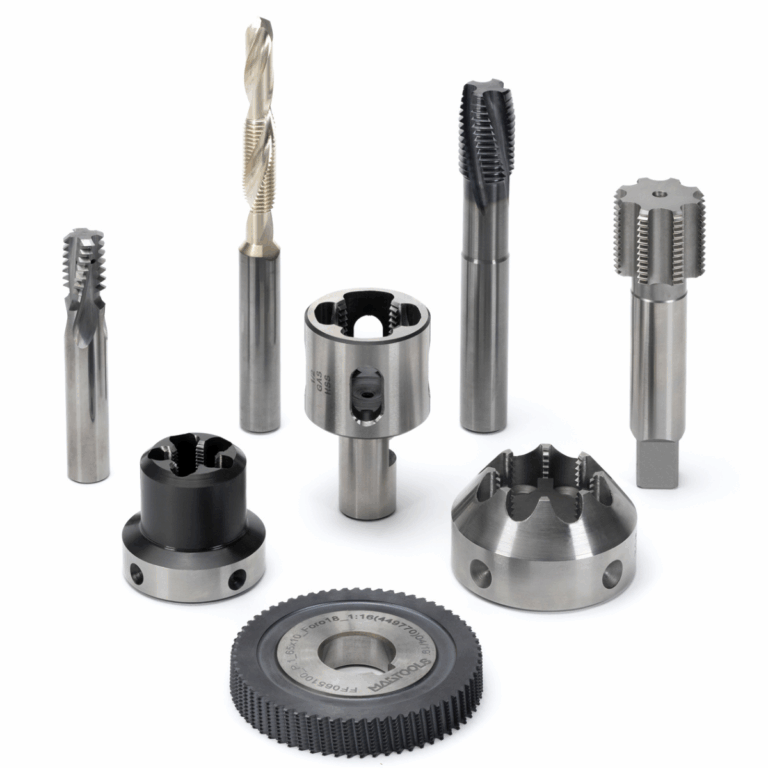
Why threading is the most critical operation on biocompatible and aerospace materials – and how to avoid breakage, out-of-tolerance results and scrap
The problem in 30 seconds
Anyone who machines titanium, Inconel or medical-grade stainless steel knows it: you can drill, mill and turn without too much drama, but when you get to threading the problems explode. Taps that snap in the hole, threads out of tolerance after just a few parts, surface finish unacceptable for the medical sector. It’s not just an impression: threading combines low cutting speed, high tool-material contact and poor chip evacuation. On materials with low thermal conductivity, this combination is lethal for the tool.
Market trends amplify the problem. The dental and orthopaedic implant sector requires increasingly small threads (M1.6–M3) in Ti-6Al-4V Grade 5 and ELI (Grade 23) alloys. The aerospace sector machines Inconel 718 for turbine components with threads that must withstand 600 °C in service. This article lines up the data: why these materials destroy threading tools, and what to do to keep them under control.
Why these three materials are critical in threading
The first enemy is thermal conductivity. A structural steel (C45) conducts heat at around 50 W/m·K: the chip absorbs a good portion of the cutting energy and carries it away from the cutting zone. Ti-6Al-4V stops at 6.7 W/m·K – nearly eight times less [1]. Inconel 718 sits at 11.4 W/m·K [2]. Even medical 316L, despite being the “best” of the three, has only 16.3 W/m·K. Result: heat remains concentrated on the tool’s cutting edge.
In threading the problem is amplified. Unlike milling, the tap works with its entire periphery in contact with the material. There is no room for coolant if the tool lacks internal delivery. Cutting speed is low (3–4 m/min on titanium, versus 30–60 m/min for milling), but prolonged contact generates an insidious thermal build-up [3].
The second enemy is work hardening. Inconel 718 and 316L are austenitic: they work-harden rapidly during cutting. The surface layer hardened by the previous pass becomes the material on which the next tooth of the tap works. In Ti-6Al-4V the mechanism is different: the low elastic modulus (approximately 114 GPa, half that of steel) causes elastic springback that “squeezes” the tap in the hole, increasing torque and wear [3][4].
| Property | Ti-6Al-4V | Inconel 718 | AISI 316L | C45 (ref.) |
| Thermal conductivity (W/m·K) | 6,7 | 11,4 | 16,3 | ~50 |
| Hardness (typical HRC) | 36 | 40–45 | 25–30* | 20–25 |
| Ultimate tensile strength (MPa) | 950–1100 | 1240–1400 | 480–620 | 600–700 |
| Elastic modulus (GPa) | 114 | 205 | 193 | 210 |
| Work hardening tendency | Medium | Very high | High | Low |
| Elastic springback | High | Medium | Medium | Low |
Table 1 – Comparison of critical properties for threading. *Work-hardened 316L can reach 30+ HRC. Sources: [1][2][4][5].
What happens in the workshop: the three failure scenarios
Scenario 1: tap broken in the hole (titanium)
Ti-6Al-4V “closes” on the tap. The low elastic modulus causes springback that progressively increases the tapping torque. If the tap does not have adequate rake angle geometry and sufficient relief, the torque exceeds the torsional strength limit and the tap breaks in the hole. On titanium medical components (dental implants, orthopaedic screws), a broken tap means a scrapped part: EDM extraction is not possible without contaminating the biocompatible surface.
Scenario 2: thread out of tolerance after 30–40 parts (Inconel)
L’Inconel 718 combines high hardness (40–45 HRC after ageing) and pronounced work hardening. The tap’s cutting edges undergo simultaneous adhesive and abrasive wear. Experimental studies show that VB (flank wear) grows rapidly: at a cutting speed of 100 m/min, the VB = 0.3 mm criterion is reached in just 90 seconds of machining [6]. Compensation of the thread’s diametral dimension becomes necessary very early, typically after 130 holes in thread milling [7].
Scenario 3: unacceptable surface finish (medical 316L)
316L is the most machinable of the three, but in threading it reveals its austenitic nature: the chip tends to adhere to the cutting edges (built-up edge), tearing material from the thread profile. The result is a surface roughness Ra unacceptable for surgical implants, where surfaces must be smooth to prevent bacterial colonisation and pitting corrosion [5].
Threading strategies: tapping vs thread milling
The first decision is strategic: traditional tapping or thread milling? The answer depends on the material, thread size and volumes.
| Criterion | Tapping | Thread milling |
| Tool breakage risk | High (tap trapped in hole) | Low (tool disengages radially) |
| Diameter flexibility | 1 tap = 1 diameter | 1 mill = multiple diameters (via CNC) |
| Thread finish | Good (if tool is new) | Excellent (multiple passes) |
| Cycle time | Faster for high volumes | Slower, but compensable |
| Ideal for titanium/Inconel | Only with specific taps, speed ≤13 SFM [3] | Recommended: lower risk, better control [8][9] |
| Breakage cost | Catastrophic (part lost) | Contained (tool replaceable) |
Table 2 – Tapping vs thread milling comparison on difficult materials. Sources: [3][8][9].
In the aerospace sector, thread milling dominates when machining high-value titanium components: a tap broken in a €50,000 part is not just an inconvenience – it’s a disaster [8]. In the medical sector, thread milling is the preferred choice for dental implants and orthopaedic screws, where perfect threads are required in very small holes in Cr-Co and Ti alloys [9].
Cutting parameters: the numbers to take to the workshop
Tapping
On Ti-6Al-4V: recommended tapping speed 10–13 SFM (3–4 m/min), both entering and exiting the hole [3]. Taps with internal coolant delivery allow higher speeds while reducing the risk of thermal build-up. For blind holes: right-hand helix taps at 10–15°, 2–3 thread chamfer. For through holes: left-hand helix at 8–10°, 4–5 thread chamfer [3].
On Inconel 718: reduce speed by 30–40% compared to titanium. Multiple passes or “peck tapping” cycles help chip evacuation. High-pressure coolant through the tool is essential: studies confirm that flood cooling delivers the longest tool life compared to MQL or dry machining [6].
Thread milling
On Ti-6Al-4V: cutting speed 15–25 m/min with TiAlN- or AlCrN-coated solid carbide thread mills. Optimising the helix angle of the cutter reduces the resultant cutting forces, as demonstrated by Araujo et al. [9] in their investigations on thread milling forces in titanium. For Inconel 718: start at 18–24 SFM (approximately 6–8 m/min) with a rigid setup [8]. Use multiple passes (“spring passes”) to ensure dimensional accuracy.
| Parameter | Ti-6Al-4V (maschio) | Ti-6Al-4V (fresa filetti) | Inconel 718 (fresa filetti) | 316L (maschio) |
| Vc (m/min) | 3–4 | 15–25 | 6–8 | 8–15 |
| Coating | TiAlN, TiCN | AlCrN, TiAlN | AlTiN, TiAlN | TiN, TiCN |
| Coolant | Emulsion >8% oil or tapping oil | High-pressure emulsion | High-pressure flood | Standard emulsion |
| Internal delivery | Strongly recommended | Recommended | Essential | Optional |
| No. of passes (thread mill) | – | 1–2 | 2–3 + spring pass | – |
Table 3 – Indicative cutting parameters for threading on difficult materials. Sources: [3][6][8][9][10].
Coatings and geometries: what makes the difference
PVD coating is a determining factor for tool life. On Ti-6Al-4V, TiAlN-based coatings deposited by magnetron sputtering have demonstrated superior performance in terms of flank wear resistance compared to uncoated tools, significantly reducing VB under turning and threading conditions [1][10]. For Inconel 718, AlTiN and TiAlN coatings are the top performers: the coating’s thermal resistance is essential when temperatures in the cutting zone reach 900–1000 °C [6].
On geometry: for tapping in titanium, the optimisation of tap design parameters (rake angle, helix angle, chamfer angle) was studied by Dogrusadik et al. [4] using a Taguchi orthogonal array on Ti-6Al-4V. The results show that coating and rake angle are the most influential factors on tap temperature and tapping torque.
For thread milling on Cr-Co alloy dental components, Araujo and Fromentin [11] analysed tool deflection during thread milling in micro-holes: the small tool size imposes a trade-off between rigidity (larger tool) and the absence of geometric interference (smaller tool). Tool design must account for both aspects.
Diagnostic table: symptom → cause → action
| Symptom | Probable cause | Corrective action |
| Tap broken in hole (Ti) | Excessive torque from springback; chip packed in flutes | Switch to taps with internal delivery; reduce Vc to 3–4 m/min; use tapping oil [3] |
| Thread out of tolerance early (Inconel) | Rapid cutting edge wear due to work hardening + temperature | Switch to thread milling with 2–3 passes + spring pass; high-pressure flood cooling [6][8] |
| Built-up edge on cutting edges (316L) | Speed too low; insufficient lubrication | Increase Vc within the permitted range; use TiCN coating; check emulsion concentration |
| Poor thread finish (all materials) | Tool flank wear beyond VB 0.2 mm; inadequate tool geometry | Replace tool; check VB with magnifier every 50 holes; consider regrinding [7] |
| Long wrapped chip (Ti) | Tap helix angle too low; feed too low | Taps with 10–15° helix for blind holes; do not go below minimum feed [3] |
| Vibrations during thread milling | Excessive overhang; insufficient setup rigidity | Reduce overhang; use shrink-fit or hydraulic tool holders; increase passes [8] |
Table 4 – Quick diagnostic guide for threading problems on difficult materials.
Operational conclusions
Three points to take to the workshop on Monday morning:
- On titanium and Inconel, seriously consider thread milling instead of traditional tapping. The cost per thread is higher, but the cost of a broken tap in a high-value aerospace or medical component is incomparably greater.
- Coolant is not optional. On Inconel 718, high-pressure flood cooling is the only strategy that guarantees acceptable tool life. On titanium, internal delivery through the tap drastically reduces the risk of breakage.
- Monitor tool wear systematically. VB grows rapidly on these materials: do not wait for a scrap part before changing the tool.
Threading on difficult materials is an operation where tool design makes the difference between a stable process and a series of machine stoppages. MadTools designs and manufactures special threading tools – taps, thread mills, form tools – optimised for the customer’s specific material and process. If you machine titanium, Inconel or medical-grade stainless steel and have problems with tool life or thread quality, contact us: we will analyse your process and design the solution.
Sources and references
[1] Strano M. et al., “Wear behaviour of PVD coated and cryogenically treated tools for Ti-6Al-4V turning”, Int. J. Material Forming, 2015. Springer.
[2] De Bartolomeis A. et al., “Future research directions in the machining of Inconel 718”, J. Mater. Process. Technol. 297:117260, 2021. Elsevier.
[3] Emuge Corp. / Modern Machine Shop, “Tips for Tapping Titanium Alloys”, mmsonline.com, 2018. Data confirmed by: Dogrusadik A. et al. (ref. [4]).
[4] Dogrusadik A., Aycicek C., Kentli A., “Optimization of tool design parameters for thread tapping process of Ti-6Al-4V”, Proc. IMechE Part E: J. Process Mech. Eng., 2021. Sage.
[5] Chakraborty S. et al., “Stainless 316L popular for orthopaedic surgical implants”, Stainless Steel World, 2025. Mechanical properties: ScienceDirect, “Surgical Stainless Steel”.
[6] Motorcu A.R. et al., “Evaluation of tool life – tool wear in milling of Inconel 718 superalloy”, Tehnicki Vjesnik, 2013. Confirmed by: Li D. et al., Lubricants (MDPI), 2022.
[7] Brandão G.L. et al., cited in: “Analysis of tool wear mechanism and wear effect of drill thread mill machining”, Int. J. Adv. Manuf. Technol., 2024. Springer.
[8] Kennametal, “Machining Guide: Thread Milling vs. Tapping”, kennametal.com. Confirmed by: guesstools.com, “Thread Mill Speeds and Feeds”, 2025.
[9] Araujo A.C., Fromentin G., Poulachon G., “Analytical and experimental investigations on thread milling forces in titanium alloy”, Int. J. Mach. Tools Manuf. 67:28–34, 2013. Elsevier.
[10] Polini W., Turchetta S., “Cutting force, tool life and surface integrity in milling of Ti-6Al-4V with coated carbide tools”, Proc. IMechE Part B, 2016. Sage.
[11] Araujo A.C., Fromentin G., “Investigation of tool deflection during milling of thread in Cr-Co dental implant”, Int. J. Adv. Manuf. Technol. 99:531–541, 2018. Springer.