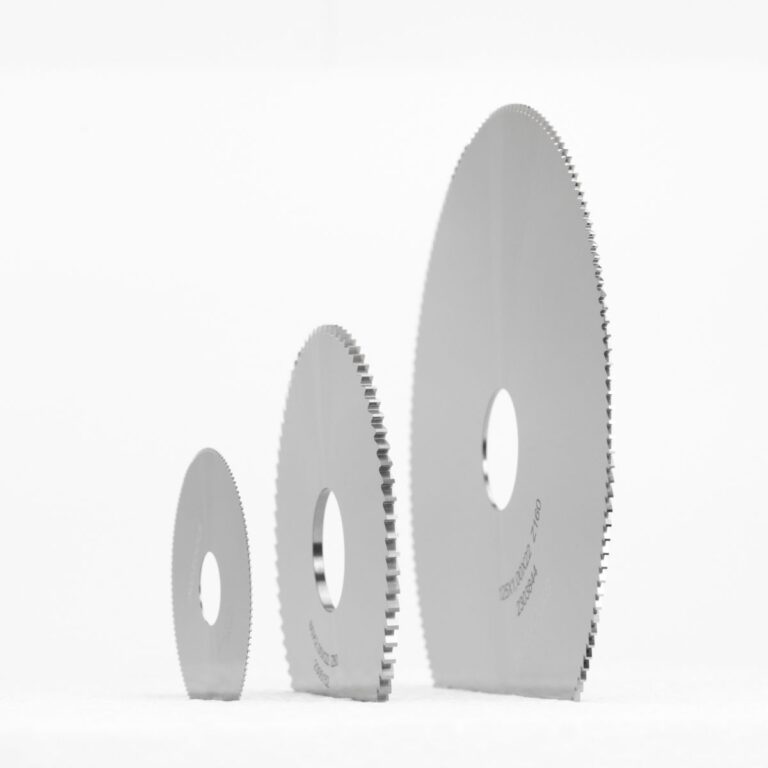
DIN 1837 or DIN 1838? Fine or coarse tooth? Technical answers to the questions that no catalogue ever properly addresses.
The solid carbide slitting saw is one of the most widely used — and most underestimated — tools in the workshop. It is often ordered out of habit: same diameter, same thickness, same supplier. Problems arise when the material, cut depth or required tolerances change: burrs, vibration, breakage, premature wear.
Unlike end mills or drills, structured technical information on slitting saws is practically non-existent in most catalogues. Diameters and thicknesses are listed without explaining when to use a fine tooth form rather than a coarse one, or why being half a millimetre off on thickness can cause blade fracture. This article provides the technical criteria — with measured data and verifiable sources — to select the right saw based on DIN standard, material, operation type and machine conditions.
DIN Standards: what the designations actually mean
DIN metal-cutting slitting saws are based on two main standards: DIN 1837 (fine tooth, tooth form A) and DIN 1838 (coarse tooth, forms B and C). The difference is not cosmetic: it concerns tooth geometry, chip pocket volume and chip evacuation capacity [1].
DIN 1837 A has a tooth pitch between 0.8 and 3.0 mm with a very sharp cutting edge, ideal for brittle materials and thin sections. The chip pocket is small: it works as long as the chip is short and thin. With high cut depths or materials that produce long chips, the pocket clogs and the blade breaks [1].
DIN 1838 B has larger teeth with a greater chip pocket, designed for parting and slotting solid material. Variant C adds an alternating tooth system (roughing + finishing) that splits the chip into three sections, reducing the risk of clogging [1]. Variant BW (alternating 45° chamfer) is also available to prevent blade seizure: RobbJack recommends it when cut depth exceeds 5 times the blade thickness [3].
| DIN Standard | Tooth Form | Typical Application | Key Features |
| DIN 1837 A | A (fine) | Slotting, screwdriver slots, brittle materials | Pitch 0.8–3.0 mm. Very sharp cutting edge. Limited chip evacuation capacity. Suited to thin sections (< 1 mm) |
| DIN 1838 B | B (coarse) | Parting, slotting, cutting solid stock | Greater chip evacuation capacity. More robust teeth. Ideal for deep cuts and tough materials |
| DIN 1838 C | C (roughing / finishing) | Cutting solid steel, high productivity | Alternating roughing + finishing teeth. Chip split into 3 sections. Better evacuation, prevents clogging and breakage |
| — (BW variant) | BW (alternating) | Deep slotting, thick-walled tubes | Alternating 45° chamfer on teeth. Prevents blade seizure in the slot. Use when depth exceeds 5× blade thickness |
Tab. 1 — DIN standard comparison for slitting saws. Sources: GSP High Tech Saws [1]; RobbJack [3].
Selecting blade thickness: the 2× rule
Blade thickness determines both the kerf width and the rigidity of the disc. A well-established rule of thumb: the depth of cut per single pass should not exceed 2 times the blade thickness [3][4]. Beyond this limit, lateral deflection increases, causing vibration and risk of breakage. If total depth exceeds 6 times the thickness, use BW tooth form. Multiple passes can create scoring inside the slot if the blade deflects differently on each pass [4].
Mounting is equally critical. Clamping flanges must have the maximum diameter compatible with the workpiece, and must be of equal size on both sides. Any particle between flange and blade — even invisible — introduces runout that translates into vibration and oversize slots [5].
| Blade Thickness | Max Recommended Depth of Cut | Application | Notes |
| 0.2 – 0.5 mm | ≤ 1.0 mm (2× thickness) | Screwdriver slots, thin slots, jewellery, electronics | Require support flanges with maximum possible diameter. Climb milling recommended |
| 0.5 – 1.0 mm | ≤ 2.0 mm (2× thickness) | Light slotting, thin-wall tube cutting, small parts | Balance between rigidity and kerf width. Fine or coarse tooth depending on material |
| 1.0 – 2.0 mm | ≤ 4.0 mm (2× thickness) | Standard slotting, small solid sections, keyways | Versatile thickness for most applications. BW alternating tooth possible for depths > 5× |
| 2.0 – 6.0 mm | Up to 12 mm with BW tooth | Parting, deep slotting, bar cutting | Prefer coarse tooth (DIN 1838 B or C). Multiple passes if depth > 2× thickness. Flood coolant |
Tab. 2 — Blade thickness selection guide. Sources: RobbJack [3]; CNC Cookbook [4]; Gaylee Saws [5].
Cutting parameters by material: speed, feed and grade
A solid carbide slitting saw is not an end mill: the disc is thin, carries many teeth and concentrates cutting forces over a small arc. Cutting speed must be significantly lower than for an end mill of the same diameter, and feed per tooth is in the order of hundredths of a millimetre.
The following table shows the parameters recommended by Hannibal Carbide for carbide-tipped slitting saws, converted to metric units [6]. For solid carbide saws, Gaylee Saws recommends a feed of 0.005–0.04 mm/tooth as a conservative starting point [5].
Grade selection depends on the material: for non-ferrous metals and cast iron, ISO K10 (WC with 6% Co, fine grain, ~92 HRA) is typically used for maximum wear resistance. For steels and stainless steel, where toughness is critical in interrupted cutting, K20 or K30 (10–12% Co) with ultrafine grain is preferred [7][8]. Santochi et al. showed that submicron grain carbides allow more pronounced positive rake angles, improving cutting action on resistant alloys [9].
| Material | Vc (m/min) | Feed (mm/tooth) | Recommended Carbide Grade | Coating |
| Aluminium and alloys (< 150 HB) | 300 – 600 | 0,10 – 0,20 | K10 (WC-Co 6%) | Uncoated / DLC |
| Low-medium carbon steel (100–250 HB) | 60 – 120 | 0,05 – 0,10 | K20 (WC-Co 10%) | TiAlN |
| Quenched and tempered steel (250–375 HB) | 45 – 90 | 0,05 – 0,13 | K20–K30 (WC-Co 10–12%) | TiAlN / AlCrN |
| Austenitic stainless steel 300 series (135–375 HB) | 23 – 45 | 0,05 – 0,10 | K30 (WC-Co 12%) | TiAlN / AlCrN |
| PH stainless steel (150–440 HB) | 23 – 45 | 0,05 – 0,10 | K30 (WC-Co 12%) | AlCrN |
| Titanium and alloys (110–380 HB) | 30 – 60 | 0,05 – 0,10 | K20–K30 (ultrafine grain) | TiAlN |
| Grey cast iron (120–320 HB) | 75 – 130 | 0,08 – 0,15 | K10 (WC-Co 6%) | TiN / Uncoated |
| Copper and brass (10–200 HB) | 60 – 240 | 0,10 – 0,20 | K10 (WC-Co 6%) | Uncoated / TiN |
Tab. 3 — Indicative cutting parameters for carbide slitting saws. Vc converted from SFPM [6]. ISO grades based on [7][8].
Practical note: on austenitic stainless steel, feed per tooth must penetrate below the work-hardened layer. If too low, the cutting edge rubs rather than cuts, accelerating wear [6][9].
Coatings: which to select for each material
PVD coating reduces friction and extends tool life. For solid carbide slitting saws, Gaylee Saws recommends [5]: TiN for general use on ferrous materials; TiCN for difficult materials (cast iron, tool steels, Inconel); TiAlN for high-temperature cutting of nickel alloys and high-alloy steels; AlCrN for maximum oxidation resistance across a wide range of materials [5]. Caution with aluminium: TiAlN can promote adhesion. An uncoated saw or DLC coating is preferable [10].
Troubleshooting: when the saw is not cutting as it should
Most slitting saw problems stem from mounting, parameters or incorrect tooth form/thickness selection — not from the tool itself. The following table links symptom, probable cause and corrective action [3][4][5].
| Symptom | Probable Cause | Corrective Action | Check |
| Excessive burrs at slot edges | Cutting speed too high or feed per tooth insufficient → cutting edge rubs rather than cuts | Reduce Vc by 20–30%. Increase feed per tooth. Check sharpness | Inspect chip: if powdery, feed per tooth is too low |
| Vibration / chatter during cutting | Blade too thin for the depth. Flanges too small. Contamination between flange and blade. Spindle play | Use maximum Ø flanges. Clean mating surfaces. Reduce depth to max 2× blade thickness. Check spindle TIR | Measure runout: must be < 0.01 mm |
| Tooth or blade breakage | Excessive Vc. Chip clogging in pocket. Work-hardened material in cutting zone. Rapid traverse impact | Reduce rpm by 50%. Apply flood coolant. Check CNC program (clearance distance). Switch to BW tooth form | Inspect teeth: uniform wear = parameters OK; localised chipping = impact or inclusion |
| Oversize slot (wider than nominal) | High runout. Flanges of different diameters. Contamination under flanges. Nut not tightened | Clean and inspect flanges. Check bore for scoring marks. Use equal-diameter flanges | Measure slot width against nominal blade thickness |
| Rapid wear / blade dulls after few cuts | Carbide grade too hard (low Co) for tough material. Vc too high generates excessive heat. Coolant absent or insufficient | Switch to higher cobalt grade (K20→K30). Reduce Vc. Ensure flood coolant on both sides | HSS turns straw colour = limit reached. Blue = temper compromised. Carbide: inspect under 10× loupe |
| Poor surface finish in slot | Insufficient side relief (dish) → body rubs. Misaligned multiple passes. Worn blade | Use hollow-ground blades. Complete cut in a single pass where possible. Resharpen blade | Check surface roughness: Ra > 3.2 µm indicates lateral rubbing |
Tab. 4 — Slitting saw troubleshooting. Sources: Gaylee Saws [5]; RobbJack [3]; CNC Cookbook [4].
Pre-mounting checklist
- DIN standard consistent with the operation: DIN 1837 A for thin slots and brittle materials, DIN 1838 B/C for parting and solid stock
- Depth-to-thickness ratio: max 2× per single pass. Above 5× → BW tooth form
- Clean flanges, spindle and blade bore. Inspect for scoring or friction marks
- Use flanges of maximum possible diameter, equal size on both sides
- Measure runout with dial indicator: must be < 0.01 mm
- Set Vc and feed/tooth from the parameters table. Start from the conservative value
- Flood coolant on both sides, especially for stainless steel, titanium and deep cuts
- Prefer climb milling to reduce cutting forces — only if the machine has minimal backlash
- Inspect the chip: short curl = OK. Powder = feed too low. Long spiral = chip pocket insufficient
Conclusions
Three points to take to the shop floor. First: DIN 1837 and DIN 1838 are not interchangeable — a fine tooth form on a deep cut in solid steel leads to breakage. Second: thickness determines process stability, not just slot width. The 2× rule is the first parameter to check. Third: carbide grade must be matched to the material being cut. K10 on stainless steel wears out in a few cuts; K30 on aluminium wastes toughness.
MadTools manufactures standard DIN solid carbide slitting saws — fine and coarse tooth, diameter 15–200 mm — with 2-day delivery. For non-standard applications (special thicknesses, custom tooth forms, bespoke geometries), the engineering department develops made-to-drawing solutions.
Sources and References
GSP – High Tech Saws, s.r.o. Technical specifications for slitting saws DIN 1837 A, DIN 1838 B, DIN 1838 C. slitting-saw.com
RobbJack Corporation. Solid Carbide Slitting Saws – Application Guide. robbjack.com
CNC Cookbook. Slitting Saw Speeds and Feeds Calculator, Arbor, & Blades. cnccookbook.com
Martindale/Gaylee Saws. Saw Cutting Recommendations – Speeds & Feeds. gayleesaws.com
Hannibal Carbide Tool, Inc. Feeds & Speeds – Milling Cutters or Saws, Carbide Tipped. hannibalcarbide.com
Mitsubishi Materials Corporation. Cemented Carbides – Grade Classification ISO K10/K20/K30. mmc-carbide.com
Luo, M. et al. (2023). Analysis of wear mechanism and sawing performance of carbide and PCD circular saw blades in machining hard aluminum alloy. Wear, Volumes 530–531. ScienceDirect.
Santochi, G., Giusti, F. (2015). Focus on Carbide-Tipped Circular Saws when Cutting Stainless Steel and Special Alloys. Advanced Materials Research, Vol. 1114, pp. 13–20. Scientific.net.
Nishio, S., Marui, E. (1996). Effects of slots on the lateral vibration of a circular saw blade. International Journal of Machine Tools and Manufacture, 36(7), pp. 771–787. ScienceDirect.