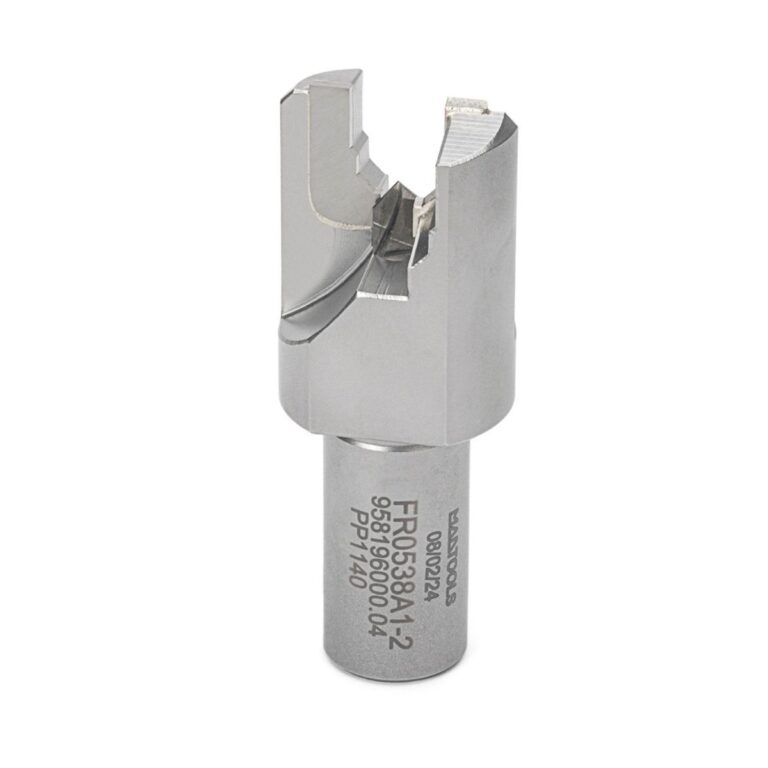
Drilling and countersinking in a single pass, reaming and turning at the same station.
How multi-operation tools reduce cycle time on transfer machines without adding stations.
The critical station constraint
On a transfer machine — rotary or linear — the cycle time is dictated by the slowest station. Each station works in parallel, but the table indexes only when the last operation is completed. If one station takes 6 seconds and the others take 3, the cycle time of the entire system is 6 seconds [1][2].
This principle has a direct consequence: reducing the time of the bottleneck station lowers the cycle time of every single part produced. On batches of 100,000–500,000 parts, even 1 second saved per cycle translates into dozens of recovered machine-hours.
The traditional approach to handling more operations than available stations offers two paths: adding a station (with structural and space costs) or accepting a second pass (doubling the critical station time). The combined tool is the third option: merging two or more operations into a single tool that completes everything in one stroke.
Time masking: the hidden advantage of the transfer machine
The key concept in transfer machines is time masking: operations at the different stations occur simultaneously. The effective cycle time is not the sum of all operations, but the duration of the slowest station [1].
Concrete example. A valve body requires 8 operations distributed across 7 stations (the eighth is load/unload). If station 4 — which performs drilling + countersinking in two passes of 3.5 s each — totals 7 s, it is the one dictating the rhythm of the entire system. A combined drill-countersink tool that performs both operations in 4.5 s reduces cycle time by 36%, freeing production capacity without any hardware investment.
Tab. 1 – Impact of the bottleneck station on daily productivity (8 h shift = 28,800 s)
| Critical station time | Effective cycle time | Parts/shift (8 h) | Difference vs 8 s |
| 8 s (two passes) | 8 s | 3.600 | — |
| 6 s (combined tool) | 6 s | 4.800 | +1.200 (+33%) |
| 5 s (optimised combined tool) | 5 s | 5.760 | +2.160 (+60%) |
Source: calculation based on cycle time = slowest station time [1][2]. Values net of indexing times (<0.3 s on modern transfer machines [3]).
Types of combined tools for transfer machines
Industry uses several configurations of multi-operation tools. Each type addresses a specific combination requirement.
Tab. 2 – Main configurations of combined tools
| Configuration | Combined operations | Typical application | Critical constraint |
| Drill-countersink (step drill) | Drilling + countersinking/spotfacing in one stroke | Screw seats, SAE/ISO hydraulic ports | Small Ø ≥ 50% of large Ø [4] |
| Drill-reamer (D-Reamer) | Drilling + finish reaming | H7 precision holes from solid | Chip evacuation between the two zones [5] |
| Multi-diameter step tool | 2–4 different diameters + chamfers | Hydraulic ports, O-ring seats | Overlapping cutting forces [6] |
| Combined form tool | Profiling + finishing + chamfer in one stroke | Complex profiles with multiple angles and radii | System rigidity and lubrication |
| Drill + thread mill | Drilling + chamfer + threading (helical interpolation) | Through-threaded holes on CNC | Requires CNC interpolation [7] |
Sources: [4] RTS Cutting Tools; [5] US Patent 2013/0058734A1; [6] Matsumura, CIRP Annals 2019; [7] Cutting Tool Engineering / Superion-Allied Machine.
Technical challenges: what can go wrong
Combining operations in a single tool is not simply “gluing two drills together”. There are real physical constraints that, if ignored, turn the advantage into a problem.
Chip evacuation. A step tool generates chips of different geometry on each diameter. Chips from the larger diameter must pass through the smaller diameter zone without clogging. If the ratio between the small and large diameter falls below 50%, the space in the flutes becomes insufficient and the clogging risk increases drastically [4]. Flute geometry must be designed specifically for each step, with dedicated rake and clearance.
Overlapping cutting forces. When two cutting zones work simultaneously — for example the drill tip and the countersink step — the axial forces add up. Matsumura and Tamura (CIRP Annals, 2019) developed a predictive cutting force model for step tools showing how torque and thrust vary non-linearly with depth, with peaks that can exceed those of a single tool by 40–60% [6].
Compromised cutting parameters. A combined tool rotates at a single spindle speed. But the small and large diameters require different cutting speeds to operate optimally. The chosen parameter will be a compromise: typically optimised for the larger diameter (which determines the critical surface finish), accepting a sub-optimal speed on the smaller diameter.
Internal lubrication. On complex step tools, the coolant supply channels must reach all cutting zones. A poorly positioned lubrication hole leaves a cutting zone “dry”, generating localised wear and the risk of chip welding [8].
When to combine and when to separate: decision criteria
Not all operations should be combined. The following table helps decide whether a combined tool is the right choice for the specific case.
Tab. 3 – Decision matrix: combined tool vs separate operations
| Criterion | → Combined tool | → Separate operations |
| Ø min/Ø max ratio | ≥ 0.50 | < 0.50 (chip cannot evacuate) |
| Critical hole tolerance | IT8 or better | IT6–IT7 (dedicated passes required) |
| Production volume | ≥ 5,000 parts/batch | Prototyping or batches < 500 |
| Critical station (bottleneck) | Yes — the saving propagates to the entire cycle | No — the saved time is masked |
| System rigidity | Rigid spindle, stable fixture | Light-duty machine, excessive overhang |
| Workpiece material | Mild steels, aluminium, brass, cast iron | Superalloys, titanium (critical forces) |
| Reconditioning available | Yes (manufacturer offers resharpening) | No (replacement cost prohibitive) |
Sources: criteria compiled from [4][6][7][9]. The Ø min/max ratio is from RTS Cutting Tools [4].
Diagnostics: typical problems with combined tools
Tab. 4 – Diagnostic guide: symptom → cause → action
| Symptom | Probable cause | Corrective action |
| Chip clogging between steps | Insufficient flute; feed too high on smaller Ø | Reduce feed by 10–15%; check flute geometry; increase coolant pressure |
| Vibration and poor finish on larger Ø | Overlapping cutting forces; excessive overhang | Reduce overhang; check fixture rigidity; consider vibration-reducing tool (asymmetric geometry) |
| Asymmetric wear between diameters | Unbalanced cutting speed; coolant not reaching all zones | Adjust rpm to critical diameter; check internal lubrication holes; evaluate differentiated coating |
| Tapered or out-of-tolerance hole | Tool deflection; spindle play; guide pad wear | Check run-out (TIR ≤ 0.01 mm); replace guide bushings; reduce depth of cut per pass |
| Premature tool breakage | Excessive torque from simultaneous cutting; sudden chip clogging | Check spindle power; add chip evacuation cycle (peck); consult manufacturer for geometry rebalancing |
Sources: issues documented in [4][5][6][8].
The real cost of one fewer tool change
On a CNC machining centre, each automatic tool change requires 2 to 8 seconds for the mechanical change (chip-to-chip), plus 1–5 seconds for spindle orientation and repositioning [10]. On a transfer machine, where the cycle is already optimised to the second, eliminating even a single tool change — or a second pass at the station — can be the factor that unlocks the productivity of the entire system.
There is also a dimensional advantage: a combined tool machines all diameters in a single setup, without repositioning the workpiece. The relative tolerances between features (concentricity between hole and countersink, coaxiality between hole and spotface) depend only on the precision of the tool, not on the accumulation of errors from multiple setups [7]. For SAE/ISO hydraulic ports with multiple angles and radii — where all dimensions are mutually referenced — this is a decisive advantage.
Conclusions
Three points to take to the workshop on Monday morning:
- Identify the bottleneck station. The cycle time of your transfer machine is the time of the slowest station. If that station performs two operations in sequence, that is where a combined tool can make the difference.
- Check the constraints before combining. Diameter ratio ≥ 0.50, compatible tolerances (IT8+), sufficient rigidity. If any one of these criteria is not met, the combined tool will create more problems than it solves.
- Have the tool designed around your cycle, not the cycle adapted to the tool. A standard combined tool rarely fits an optimised transfer cycle. Custom design — with dedicated flute geometry, force balancing and internal lubrication — is what distinguishes a tool that works from one that breaks.
MadTools designs and manufactures custom combined tools for transfer machines and machining centres. The team of 5 design engineers analyses the existing cycle, identifies combinable operations and develops the tool with geometry, material and coating optimised for the specific application. The service includes specialised resharpening to maximise tool life.
Sources and references
[1] Production Machining — “Transfer Machines”. productionmachining.com. “The overall cycle time is determined by how long it takes to complete the slowest operation.”
[2] Wikipedia — “Rotary transfer machine”. Accessed February 2026.
[3] Winema RV10 Flexmaster — Production Machining, 2022. Table indexing time < 0.3 s.
[4] RTS Cutting Tools — “Custom Step Drill Builder”. rtscut.com. “The Step Drill is not practical with a small diameter less than 50% of the large diameter.”
[5] US Patent 2013/0058734A1 — “Combined drill and reamer tool”. Analysis of the operation and limitations of drill-reamer tools.
[6] T. Matsumura — “Practical implementation of cutting force model for step drill using 3D CAD data”. CIRP Annals, Vol. 68, Issue 1, pp. 65-68, 2019.
[7] Cutting Tool Engineering — “Benefits of combining cutting operations in a single tool”. Whitepaper, 2017. Al Choiniere / Superion (Allied Machine & Engineering).
[8] N. Rupasinghe et al. — “Investigation of Chip Evacuation in Ejector Deep Hole Drilling”. Procedia CIRP (18th CIRP ICME), 2024.
[9] Shop Metalworking Technology — “Benefits of a Multi-Function, Single Tool”. shopmetaltech.com, 2022.
[10] CNC Concepts Inc. — “Can you speed up your tool change time?”. cncci.com. Tool change times: 2–8 s mechanical + 1–5 s spindle orientation.