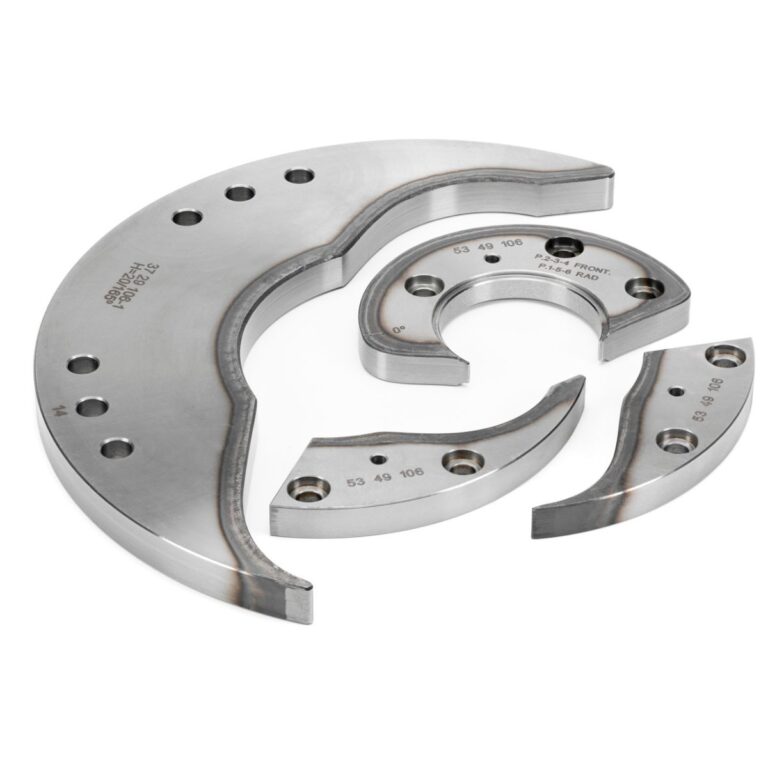
How the motion law, material and heat treatment of a cam determine cycle time, tool life and part quality on a mechanical multi-spindle lathe.
The hidden cycle time multiplier
On a cam-driven multi-spindle lathe — Gildemeister, Schütte, Mori-Say, Wickman, Index — cycle time is dictated by the slowest station. If that station takes 0.3 seconds longer than necessary due to a poorly designed cam transition, a batch of 500,000 parts loses over 40 hours of production. It is not the spindle that slows things down: it is the profile.
Yet the cam is often the last component to receive design attention. It is ordered “same as before”, a twenty-year-old profile is replicated, and the problems — vibration, wear, out-of-tolerance dimensions — are attributed to other causes. This article brings order: motion laws, materials, heat treatments and criteria for deciding when to redesign.
Motion laws: what actually changes on the profile
The motion law defines how the follower (the tool-carrying slide) moves during camshaft rotation. Not all laws are equivalent: each has a different trade-off between peak velocity, maximum acceleration and jerk (the derivative of acceleration). Jerk is the critical parameter: infinite jerk generates an instantaneous force impulse that excites vibrations in the kinematic train [1].
The fundamental law of cam design states that the position, velocity and acceleration of the follower must be continuous, and jerk must be finite. If this condition is not met, the mechanism produces impacts, vibrations, noise and accelerated wear [1][2].
The following table compares the most widely used motion laws. The coefficients Cv, Ca and Cj are dimensionless and allow direct comparison for equal stroke and working angle [2][3].
| Motion law | Cv (max vel.) | Ca (max acc.) | Cj (jerk) | Characteristic |
| Cycloidal | 2,00 | 6,28 | 39,5 | Continuous jerk |
| Mod. trapezoidal | 2,00 | 4,89 | 61,4 | Lowest acceleration |
| Modified sine | 1,76 | 5,53 | 69,5 | Lowest velocity |
| Simple harmonic | 1,57 | 4,93 | ∞ | Infinite jerk at boundaries |
| Polynomial 3-4-5 | 1,88 | 5,77 | 60,0 | Good compromise |
Tab. 1 — Characteristic values of the main cam motion laws (dwell-to-dwell). Cv, Ca, Cj are normalised dimensionless coefficients [2][3].
In practice: the cycloidal is the safest choice for high-speed lathes, because jerk is continuous and residual vibrations during the dwell phase are minimal. The modified trapezoidal has the lowest peak acceleration — useful when the follower train mass is high — but the discontinuous jerk can generate vibrations [2]. The modified sinusoidal (Neklutin) offers the lowest peak velocity but the highest jerk: it is common in indexing mechanisms but risky at high speed [3].
Pressure angle: the geometric limit not to exceed
The pressure angle φ is the angle between the direction of follower motion and the normal to the cam profile at the contact point. It represents the efficiency with which the cam transmits motion: when φ = 0° all force goes into useful motion; when φ = 90° the follower does not move [1][4].
For translating followers (slides), the practical limit is φ ≤ 30°. For oscillating arm followers, up to 35° is acceptable. Beyond these values, friction increases to the point of risking guide seizure [4]. If the calculated pressure angle exceeds the limit, there are two options: increase the base circle radius (larger cam) or distribute the stroke over a larger rotation arc [4].
This is a key point for those who replicate cams “same as before”: if the original profile was at the limit and the guides have since worn, the effective pressure angle may already be beyond the critical threshold.
Materials and heat treatments: choosing based on load
The cam operates under cyclic contact loading: the failure mechanism is contact fatigue (pitting), triggered by surface micro-cracks when the Hertzian stress exceeds the material limit [5][6]. The choice of material and heat treatment determines cam life.
| Material | Surface hardness (HRC) | Treatment | Application | Limitation |
| C45 (1.0503) | 50–55 | Induction hardening | Standard cams, medium runs | Limited case depth |
| 16MnCr5 (1.7131) | 58–62 | Case hardening | High-volume, high-load applications | Post-treatment distortion |
| 42CrMo4 (1.7225) | 50–56 | Nitriding | High-speed cams | Thin case (0.3–0.5 mm) |
| 100Cr6 (1.3505) | 60–64 | Through hardening | Small cams, high-wear applications | Limited toughness |
| Nodular cast iron | 45–55* | Surface hardening | Cast cams in large volumes | * With localised treatment |
Tab. 2 — Materials and heat treatments for multi-spindle lathe cams. Hardness values from standard treatment specifications [6][7][8].
Case-hardened 16MnCr5 (EN 10084, W.Nr. 1.7131) is the reference material for high-load cams in large production runs. Carburising at 880–930 °C followed by oil quenching produces a martensitic surface layer at 58–62 HRC, with a tough core at 30–35 HRC that absorbs impact loads [7]. The case depth is typically 0.5–1.2 mm [7].
Nitrided 42CrMo4 is the alternative when post-treatment distortion is unacceptable: nitriding takes place at lower temperatures (500–580 °C) and produces less deformation, but the hardened layer is thinner (0.3–0.5 mm) [8].
A frequently overlooked aspect: the follower (roller or flat-face) must be at least 2 HRC harder than the cam. When the relative hardness is correct, the roller tends to polish the cam surface, extending its service life [5][6].
Diagnostics: when the cam is the problem
Cam-related problems often manifest as part defects or abnormal tool wear, and are attributed to other causes. The following diagnostic table helps trace the cam as the source of the problem.
| Symptom | Probable cause | Corrective action |
| Vibration during stroke | Infinite jerk at transitions (simple harmonic law) or pressure angle > 30° | Switch to cycloidal or modified trapezoidal law; verify base circle radius |
| Accelerated wear on cam flank | Insufficient surface hardness or inadequate lubrication | Check HRC (min. 55 on steel); verify oil flow rate and lubricant type |
| Oval bore or out-of-tolerance dimension | Excessive follower-to-cam clearance; worn profile altering the stroke | Measure profile with dial gauge; replace cam if deviation > 0.02 mm |
| Cyclic metallic noise | Loss of follower-to-cam contact (lift-off) | Check return spring preload; reduce peak velocity or acceleration |
| Pitting on cam surface | Contact fatigue (Hertzian stress exceeding material limit) | Redesign transitions to reduce minimum radius of curvature; consider harder material |
Tab. 3 — Diagnostic table symptom → cause → action for cam-related problems on multi-spindle lathes [1][5][6].
Criteria for deciding when to redesign
Replacing a worn cam with an identical copy is the quickest option. But it is not always the most effective. Redesign makes sense in specific situations.
| Situation | Recommended action |
| The critical station cycle time is the bottleneck and cannot be reduced by tooling alone | Redesign the cam with a low-acceleration motion law (mod. trapezoidal) to reduce the idle phase |
| Frequent product changeovers require different strokes | Consider dedicated cam sets for part families; compare set cost vs. setup time |
| Persistent vibration despite correct maintenance | Profile analysis with dial gauge measurement; comparison with theoretical profile; possible redesign using cycloidal law |
| Cam wear < 50,000 parts | Material or treatment is not adequate for the load; consider upgrade to case-hardened 16MnCr5 or nitrided 42CrMo4 |
| Transition from cam lathe to CNC but retention of some mechanical stations | Redesign the remaining cams integrating the new cutting parameters optimised for updated tooling |
Tab. 4 — Decision criteria for cam redesign on multi-spindle lathes.
Redesign always starts from a survey of the existing profile (dial gauge or CMM) and an analysis of the stroke-angle diagram. Comparing the actual profile with the theoretical one makes it possible to quantify wear and decide whether simple replacement is sufficient or whether intervention on the motion law, the material, or both is required.
Conclusions
Three things to take back to the shop floor. First: if you have recurring vibration at a station, check the cam motion law before replacing the tool — a profile with infinite jerk (simple harmonic) is often the hidden culprit. Second: a C45 induction-hardened cam with hardness below 55 HRC on a cycle running hundreds of thousands of parts is undersized — consider upgrading to case-hardened 16MnCr5. Third: when the critical station cycle time will not come down any further, the cam is the first place to look for margin, not the last.
MadTools designs and manufactures standard and custom cams for Gildemeister, Schütte, Mori-Say, Wickman and Index multi-spindle lathes. The team of 5 engineers analyses the working cycle, defines the optimal motion law and selects material and treatment according to the required load and service life.
Sources and references
[1] R.L. Norton, Cam Design and Manufacturing Handbook, Industrial Press, 2009. Ch. 8–10: motion laws, dynamics and vibrations.
[2] Nolte NC-Kurventechnik, “Motion Laws for Cam Gears and Servo Drives” — characteristic values table Cv, Ca, Cj for normalised motion laws. nolte-nc-kurventechnik.de
[3] H. Qiu et al., “Design and analysis of high-speed cam mechanism using Fourier series”, Mechanism and Machine Theory, Vol. 104, 2016, pp. 118–129. ScienceDirect.
[4] R.L. Norton, Design of Machinery, McGraw-Hill, 2020. Ch. 7: pressure angle and base circle sizing.
[5] P. Folęga et al., “Impact of the cam and follower cooperation and of lubrication on wear”, Archives of Materials Science and Engineering, Vol. 58(2), 2012, pp. 211–218.
[6] ISO 6336 Part 5 — Contact fatigue strength limit for steels with various heat treatments. Table of allowable contact stress values for case hardening, nitriding and through hardening.
[7] EN 10084:2008 — Case hardening steels: 16MnCr5 (1.7131). Surface hardness after case hardening and quenching: 58–62 HRC; case depth: 0.5–1.2 mm.
[8] M. Yang, H. You, R.D. Sisson, “Nitriding and Ferritic Nitrocarburizing of Quenched and Tempered Steels”, Proc. HT2021, ASM International, 2021.