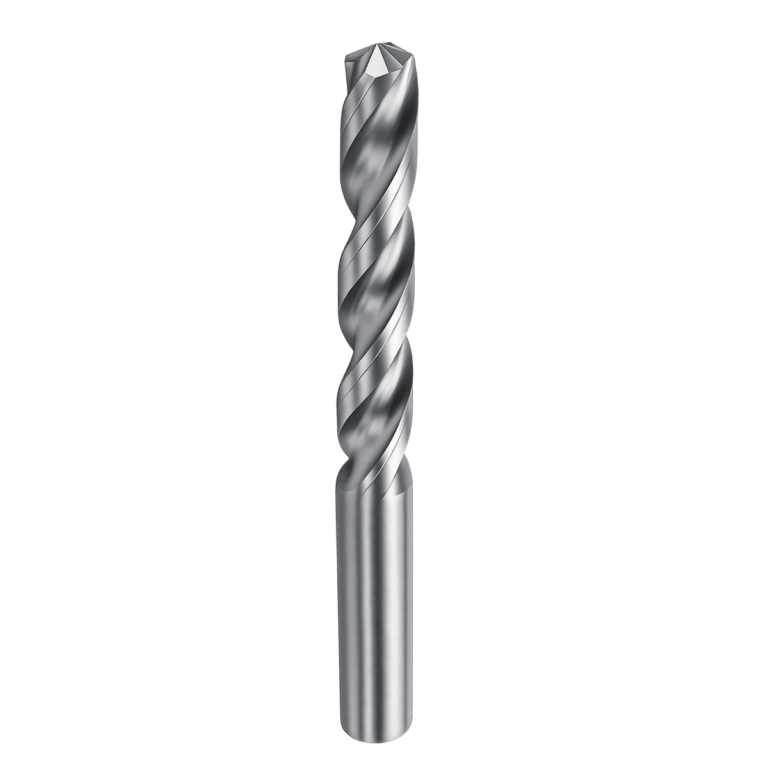
A practical guide to real-world problems and how to address them for diameters from Ø1 to Ø25 mm
Deep hole drilling with a depth-to-diameter ratio between 5 and 20 is one of the most critical machining operations.
In this range, chip evacuation, temperature control, hole stability, and tool life become difficult variables to manage.
1. Chip clogging and tool breakage
When chips are not evacuated continuously, they pack in front of the cutting edge, causing:
- Increased cutting torque
- Localized overheating
- Sudden drill breakage
This problem is critical with materials that produce long chips (austenitic stainless steels, titanium).
The chip curls and gets stuck in the evacuation channel.
2. Insufficient thermal control
The coolant must reach the cutting edge deep inside the hole with sufficient pressure to cool and push the chips away. If the pressure is too low or the channel is poorly designed, the temperature rises rapidly, compromising surface quality and tool life.
3. Axial deviation
As depth increases, the hole tends to deviate from the theoretical axis due to:
- Unbalanced cutting forces
- Tool deflection
- Lack of lateral guidance
Result: crooked, ovalized, out-of-tolerance holes.
4. Irregular surface roughness
Vibrations, chip accumulation, and uneven cutting-edge wear leave scratches and areas with variable roughness on the hole wall.
Technical Solutions
1. Correct drill geometry
Gun drill (single-lip) – the ideal solution for Ø1–25 mm when high quality is required:
- Single cutting edge with an internal coolant channel
- Chip evacuation through a V-shaped groove
Critical geometric elements:
- Rake angle: affects chip formation and temperature
- Chip breaker: determines whether the chip breaks or remains long
- Evacuation channel: sized according to the chip type
2. Properly sized coolant system
Parameters to control:
- Pressure: 20–80 bar depending on diameter and depth (for gun drilling)
- Coolant quality
- Stable emulsion concentration
- Effective filtration (suspended chips reduce lubrication)
- Controlled temperature
3. Optimized cutting parameters
Cutting speed and feed must be calibrated together. In deep hole drilling, it is better to be conservative: a longer but stable cycle produces fewer rejects than aggressive parameters.
4. Machine system rigidity
Checkpoints:
- Spindle concentricity
- Toolholder rigidity
- Workpiece–spindle alignment
Monitoring: variations in torque and abnormal vibrations indicate issues in progress.
Practical Case: Ø3 mm × 24 mm on Ti6Al4V Titanium
Application: through-holes for medical implants
Tolerances: straightness 0.05 mm, Ra < 0.8 µm
Problem:
- 15% scrap rate
- Tool breakage every 20–25 holes
- Scratched surface finish
Cause:
- Standard drill with undersized evacuation channel
- Insufficient coolant pressure (30 bar)
Solution:
- Gun drill
- V-groove optimized for titanium chips
- Coating + superfinishing
- Coolant pressure increased to 70 bar
- Parameters: Vc 18 m/min, f 0.02 mm/rev
Results:
- Scrap rate: 2%
- Tool life: 180–200 holes
- Straightness: 0.03 mm