A coating just a few microns thick can increase tool life by 2–3× under favorable conditions. But it can also make things worse if the coating is wrong, the substrate isn’t properly prepared, or the process isn’t under control. The difference comes down to the choice—and, in some cases, the best choice is to leave the tool uncoated.
The main coatings (in practice)
TiN — Titanium Nitride
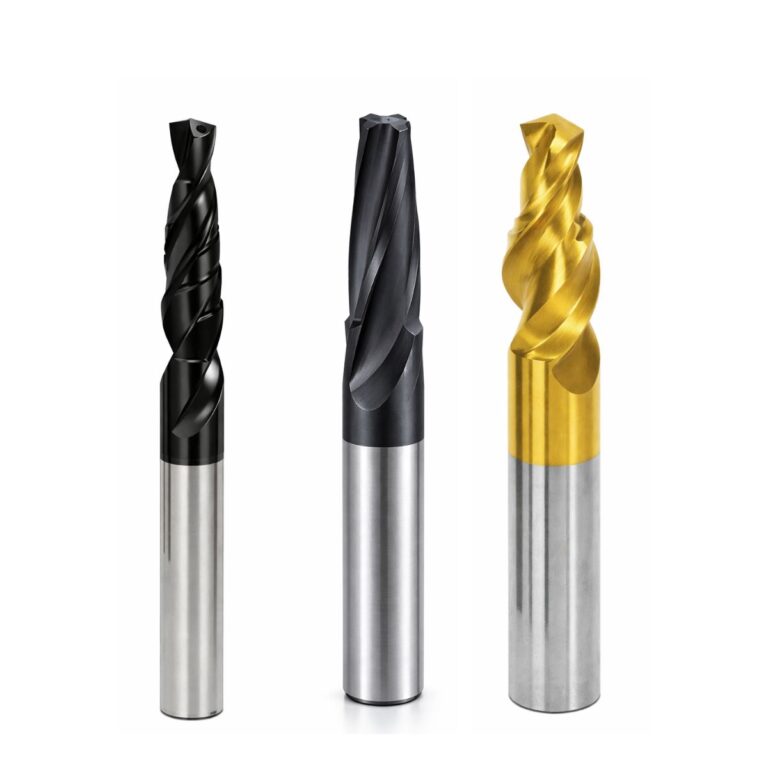
Golden color, hardness 2300–2500 HV, max temperature 600 °C, typical thickness 2–4 µm.
It’s the “classic”: inexpensive, works well for general machining and moderate speeds. It makes sense on HSS drills for drilling mild steels, for budget-limited applications, and in the medical sector, where biocompatibility is a recognized factor (note: certifications and requirements depend on the supplier and the process). The golden color also makes it visually identifiable—useful as an identification or decorative coating.
Avoid it when cutting temperatures rise above 600 °C (high speed, hardened steels, stainless): today there are better-suited solutions. For demanding applications, it has largely been surpassed by newer generations.
TiAlN — Titanium Aluminum Nitride
Dark violet/black color, hardness 2800–3500 HV, max temperature 800–900 °C, typical thickness 2–5 µm.
It’s the safest “default”—the all-rounder of modern coatings. It covers about 80% of current applications: high-speed milling on quenched-and-tempered steels, general-purpose drilling, turning. It withstands high temperatures thanks to the formation of a protective Al₂O₃ layer, offers an excellent performance/price ratio, and works on both carbide and HSS. Particularly suitable for dry machining or MQL. It’s the first choice when you don’t have extreme, specific requirements.
Important note: on aluminum and light alloys it tends to promote adhesion and chip welding—often not the right choice. On stainless steels it works, but when you need the maximum performance it’s better to move to AlCrN.
AlCrN — Aluminum Chromium Nitride
Metallic gray color, hardness 2800–3200 HV, max temperature 1100 °C, typical thickness 2–5 µm.
When TiAlN reaches its limit, AlCrN is often the next step: +200 °C of thermal headroom and good resistance under severe conditions. It’s used on austenitic and duplex stainless steels (always validate on the specific grade and real parameters), on superalloys such as Inconel and Hastelloy, in gear cutting on difficult steels, and in interrupted cuts at high temperature. It has a low tendency to chip welding.
Downsides: it costs more and it’s easy to over-spec. If TiAlN works, AlCrN is wasted money. It only makes sense when temperatures exceed 800 °C or when TiAlN has shown concrete limits.
DLC — Diamond-Like Carbon
Gray-black color, high hardness but strongly dependent on type (a-C:H, ta-C, doped), coefficient of friction 0.05–0.15, max temperature 300–400 °C (depends on type and atmosphere), typical thickness 1–3 µm.
This is the anti-adhesion coating par excellence: very low friction, extremely smooth surface. Perfect for aluminum and light alloys, non-ferrous materials, composites (CFRP, GFRP), and reinforced engineering polymers. On titanium it can work, but only in specific low-temperature cases and finishing operations. It suits dry machining and should be chosen when chip welding is the main issue.
Key limitation: thermal stability. Many variants degrade already around 300–400 °C, which rules it out for most steel machining. On steels, use must be evaluated case by case considering temperature, adhesion, the possibility of multilayer stacks, and lubrication—but in general it is not the first choice. High cost.
TiCN — Titanium Carbonitride
Dark blue-gray color, hardness 2800–3200 HV, max temperature 400–500 °C (depends on formulation and process), typical thickness 2–4 µm.
Less known than the previous ones, but it has its niches. Harder than TiN, low friction coefficient, good performance/cost balance. It works well for blanking and sheet forming, tapping (where torque reduction is a real advantage), finish reaming, and moderate-speed applications.
Limits: lower thermal stability than TiAlN, which penalizes it at high speeds. If TiAlN is available under equivalent conditions, TiAlN is preferable.
Next-generation coatings
For applications where standard coatings aren’t enough, two interesting families exist today.
Nanocomposites (nc-AlCrN, nc-TiAlN) have a nanocrystalline structure with grain sizes of 5–15 nm and reach hardness values of 35–45 GPa with improved toughness. They’re used on hardened steels above 55 HRC, in critical applications with thermal shock, and whenever standard coatings have shown their limits.
Multilayer and superlattice architectures, based on alternating nanometric layers, provide a 30–50% hardness increase compared with monolayers and improved fatigue resistance. They are used on precision tools with tolerances under 10 µm, microtools with diameters below 3 mm, and wherever the highest absolute performance is required.
When it’s better NOT to coat
Do not coat (or consider ultra-thin coatings under 1 µm) in these situations:
Tool already “top”. PCD (Polycrystalline Diamond), CBN (Cubic Boron Nitride), and many ceramics do not gain real benefits from coatings. They’re already extremely hard, and ceramics also have thermal incompatibility issues. A coating can create adhesion problems rather than solve them.
Critical geometries. Cutting edges with radii under 5 µm (razor-like tools, scalpels), critical sharp corners, and dimensional tolerances under 3 µm: a 2–5 µm coating alters geometry, risks rounding the edge, and can create stresses on very sharp profiles. Either go ultra-thin or don’t coat.
Economically pointless. Tool under €5, expected tool life under 10 parts, occasional production: coating typically costs €15–30, so ROI is negative by definition. Spending €20 on coating to save a €5 tool makes no sense.
Damaged substrate. Nitrided tool steels (the white layer is damaged during processing), substrates with cracks, porosity or surface defects, materials with incompatible thermal expansion, tools already poorly coated without stripping: the coating won’t adhere properly or will worsen existing defects. The rule is simple: restore first, then coat.
Low speeds with abundant oil. Below 30 m/min, with straight oil, temperatures under 200 °C and soft materials (pure aluminum, copper, brass): wear is already minimal, lubrication is doing its job, coating is just extra cost. Exception: if the real issue is anti-adhesion on aluminum, DLC can still make sense even in these conditions.
“Dirty” machining. Cast iron with slag, highly abrasive materials with hard particles, mill scale: extreme abrasive wear consumes the coating quickly—it is literally torn away. Better a cheaper tool replaced more often.
Practical selection rule (without overcomplicating)
First: is coating even worth it? Six quick questions. Does cutting temperature exceed 400 °C? Does the tool cost more than €15? Is current tool life under 100 parts? Is there a chip adhesion problem? Are cutting parameters aggressive? Is machining dry or MQL? If at least three answers are yes, coating probably makes sense. If fewer than three are yes, evaluate carefully. If all are no, probably don’t coat.
For coating selection, priority goes to the work material and expected temperature (priority 1), then operation type and budget (priority 2), and finally volumes (priority 3). In practice:
Standard steels? Start with TiAlN—it’s the safe default. Stainless, superalloys, aggressive cutting? Consider AlCrN, and in extreme cases (hardened above 50 HRC) nanocomposites. Aluminum, adhesive materials, composites? DLC. Tight budget, HSS, general use? TiN, or TiCN in some specific applications such as tapping and blanking.
The five classic mistakes
“More expensive = better.” AlCrN on mild steels at low speed is a waste. A nanocomposite on a simple drilling operation is pointless. TiAlN on mild steels is sufficient and economical—AlCrN only makes sense above 800 °C.
“Same coating for everything.” TiAlN on everything, aluminum included—or DLC on everything, steels included: both are common mistakes. Coating must be chosen by material: DLC for aluminum (and, in specific cases, titanium), TiAlN/AlCrN for steels.
“Coating defective tools.” Coating a tool with cracks makes the situation worse. Coating over a poorly applied layer without stripping is equally counterproductive. First repair and regrind, clean and strip if needed, then coat on a sound substrate.
“Not communicating the application.” Saying “apply TiAlN” without explaining the use prevents the partner from optimizing the process. Specify material, speed, lubrication: the outcome changes.
“Expecting miracles.” Coating doesn’t solve everything. Wrong cutting parameters + coating = failure anyway. Coating can deliver 2–3× tool life under favorable conditions—meaning material, parameters and coating are all correct. If one of the three is wrong, coating can even reduce performance.
The process matters as much as the coating
An excellent coating applied poorly is worse than no coating. Coating quality depends on the deposition technology (Arc, Magnetron Sputtering, HiPIMS, PACVD), surface preparation (cleaning, etching), process control (temperature, pressure, bias), and final quality checks (adhesion, thickness, uniformity).
Relying on a single supplier means accepting their constraints: if they only have Arc PVD, they will always propose that—even when Magnetron Sputtering would be more suitable. Limited catalog, rigid prices, fixed lead times, no backup in case of issues.
MadTools made a different choice: instead of investing in in-house equipment, it built a network of four specialized partners with complementary technologies—Arc PVD (three partners), Magnetron Sputtering (two partners), HiPIMS (one partner), PACVD (two partners)—so each tool is routed to the most suitable process rather than forcing the same solution on everything.
Concrete example: a customer requests coating for a 1 mm end mill intended for milling Inconel 718. The partner specialized in standard TiAlN is not the right choice. The one offering AlCrN via magnetron sputtering is a good option. The one with HiPIMS nanocomposites is the optimal solution. MadTools chooses the latter. With a single supplier, the customer would have received what was available, not what was best.
Practical customer benefits: optimal coating selection (not just what’s available), lead-time management across multiple suppliers with the ability to route urgent jobs, cost optimization through negotiation on cumulative volumes (small lots under 50 pieces to the specialist partner, large lots over 500 to the partner with scale economies), and operational redundancy—quality issue or plant stoppage at one partner? Immediate switch to another, zero interruptions.
Each partner was selected for a vertical specialization. Partner A covers high-volume HSS tools (volumes over 200 pieces, low costs). Partner B focuses on precision microtools (diameters below 3 mm, critical tolerances). Partner C is the reference for advanced HiPIMS coatings and nanocomposites. Partner D is the fast partner: 3–5 day lead time, urgent jobs and small lots.
The MadTools process follows five steps: application analysis (material, operation, parameters, lubrication, volumes), technical recommendation (optimal coating, required preparation, realistic expectations—or advice not to coat), partner selection (technology, lead time, quality/price ratio), full management (tool pickup, shipment to partner, incoming QC, delivery to customer), and production performance follow-up with an application history for future references.
To give a sense of the difference: a single supplier typically offers 1–2 technologies and 8–12 catalog coatings, limited flexibility on lead times and pricing, minimum lots of 50–100 pieces, and sales-driven technical support. The MadTools network provides 5–6 technologies and 25–30 coatings, high flexibility, lots starting from 1 piece, three backup alternatives, and support from an application engineer.
Want a fast, sensible recommendation?
If you send us the material, operation (milling/drilling/reaming…), parameters (vc/fz), lubrication (dry/MQL/emulsion/oil) and volumes, the MadTools technical team can point you to the most coherent coating—or honestly tell you when coating isn’t worth it.
Contact the MadTools technical team for a tailored consultation.