The problem: choosing by habit, not by analysis
Keyways to DIN 6885 are among the most common internal profiles in power transmission components: gears, pulleys, couplings, hubs. Yet in many workshops the choice between broaching and slotting is made by inertia — the available machine is used, not the right one.
The result is a silent compromise: inflated tooling costs, non-optimised cycle times, or tolerances pushed to their limits. This article compares the two technologies using measured data, to give production decision-makers a concrete reference.
How they work: two opposing cutting philosophies
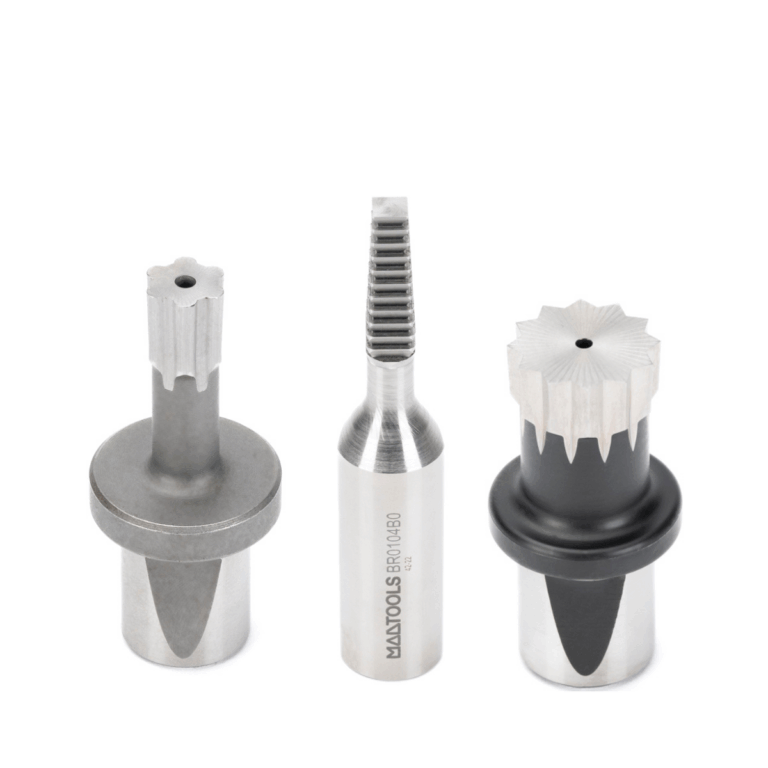
A broach is a multi-tooth tool with teeth arranged in sequence, each slightly larger than the previous one. The profile is completed in 1–3 passes: each tooth removes a defined increment (RPT – Rise Per Tooth, typically 0.02–0.15 mm). The operation combines roughing, semi-finishing and finishing in a single stroke [1].
According to DIN 8589-5 classification, the cutting motion is linear and unidirectional, with feed determined by the tool geometry rather than the machine. The result is high dimensional repeatability: industrial applications achieve IT6/IT7 with surface roughness Ra ≤ 0.8 µm [1].
Slotting uses a single cutting edge operating in a reciprocating vertical motion. Material is removed on the downstroke; the return stroke is passive. Depth of cut is incremented with each pass along the X-axis (typically 0.02–0.05 mm/pass) [2][3].
It can be performed on dedicated slotting machines, CNC lathes (with spindle locked and slotting tool mounted on the turret), or multitasking machining centres. The single-point insert is available in HSS-PM or carbide, in standard widths from 2 to 25 mm with tolerances H7, JS9, P9, D10 and C11 [2][3].
Direct technical comparison
| Parameter | Conventional broaching | Slotting (single-point tool) |
| Cutting principle | Multi-tooth, 1–3 passes | Single cutting edge, multiple passes |
| Achievable accuracy | IT6–IT7 [1] | IT7–IT9 [2][3] |
| Surface roughness (Ra) | ≤ 0.8 µm [1] | 1.6–3.2 µm (depends on material and setup) [2][3] |
| Blind keyways | No (requires full pass-through) | Yes (main advantage) [2][4] |
| Tooling cost | High (dedicated broach per profile) | Low (indexable insert) [2][3] |
| Cycle time per keyway (C45 steel) | 5–15 s per keyway [1] | 60–300 s per keyway (depends on depth) [2] |
| Machine required | Dedicated broaching machine | Slotting machine, CNC lathe, multitasking centre [2][3] |
| Profile flexibility | Low (1 broach = 1 profile) | High (insert change covers different widths) [2] |
| Minimum economic batch size | Medium-high (> 500–1,000 pcs) | Even single parts [2][3] |
Tab. 1 – Technical comparison: broaching vs slotting. Sources: [1] Arrazola et al., CIRP Annals 2020; [2] Gisstec, 2025;[3] HPProc, 2018.
What happens on the shop floor: real-world issues
Broaching: fast but inflexible
The conventional broach is unbeatable for high-volume through-keyway production. The issue lies entirely in the initial cost and rigidity: any change in width, tolerance or profile requires a different broach. On mixed-production runs or prototypes, the tooling cost outweighs the machine cost.
Chip evacuation in deep internal keyways is a documented critical point: Fabre et al. showed that at high RPT and low cutting speeds, surface roughness deteriorates significantly due to chip pocket clogging [5]. Furthermore, the broach can only be used for through-keyways: blind bores are not an option [4].
Slotting: flexible but slow
CNC lathe slotting eliminates part re-clamping: the keyway is cut in the same setup as turning, drilling and boring. This is its main competitive advantage for small and medium batches. It can machine blind keyways (with adequate undercut relief) and is adaptable to non-standard profiles.
The limitation is cycle time: with typical pass depths of 0.02–0.05 mm, a 4 mm deep keyway in C45 steel requires 80–200 strokes. Tool deflection in deep, narrow keyways is the most insidious problem: the longer the toolholder, the more it flexes under cutting forces, producing “bell-mouthed” keyways (wider at the bottom) [6].
Insert material: HSS-PM or carbide?
In CNC lathe slotting, insert material selection is counter-intuitive. Carbide seems the obvious choice, but it is not for this process. Gisstec, one of the leading manufacturers of slotting systems, clearly documents the issue: carbide is unsuitable for slotting because its low fracture toughness does not ensure process reliability [2].
In practice: a carbide insert may perform well for 100 keyways, but the cutting edges risk chipping after only a few operations. Powder metallurgy HSS alloys (HSS-PM) with TiN coating provide higher compressive strength and more consistent tool life. In conventional broaching, HSS remains the dominant material for the same reasons, although carbide tools with process monitoring are used for aerospace applications on superalloys [1][7].
Cutting parameters: operational reference data
The following table lists indicative parameters for CNC lathe slotting with a single-point insert, based on tooling manufacturer data. Values must be adapted to the machine, setup rigidity and specific material.
| Workpiece material | Stroke speed (m/min) | Pass depth (mm) | Insert material | Coolant |
| Steel C45 / 8620 | 5–6 | 0,02–0,04 | HSS-PM + TiN | Emulsion 10–15% |
| Hardened steel 4140 | 4–5 | 0,015–0,03 | HSS-PM + TiN | Emulsion 10–15% |
| Aluminium (6061 / 7075) | 8–14 | 0,03–0,06 | HSS-PM or carbide | Emulsion or air |
| Cast iron (GJL-250) | 4–6 | 0,02–0,04 | HSS-PM + TiN | Dry or MQL |
| Austenitic stainless steel (304/316) | 3–5 | 0,015–0,03 | HSS-PM + TiAlN | Flood coolant |
Tab. 2 – Indicative parameters for CNC lathe slotting with single-point insert. Sources: [2] Gisstec, 2025; [7] CNC Broach Tools, 2025.
For conventional broaching, Fabre et al. report that surface roughness improves significantly as cutting speed increases up to 50 m/min, even under dry conditions: Ra values obtained at 50 m/min are consistently lower than those at lower speeds [5]. This finding is counter-intuitive but experimentally confirmed on stainless steel X12Cr13.
When to choose which: decision tree
| Production scenario | Recommended choice | Rationale |
| Batch > 1,000 pcs, through-keyway, standard DIN 6885 profile | Conventional broaching | Minimum cycle time, lowest cost per part |
| Batch < 200 pcs, variable profiles, part already on lathe | CNC lathe slotting | Zero re-clamping, low tooling cost, maximum flexibility |
| Blind keyway | Slotting (only direct option) | Broaching requires full pass-through [4] |
| Width tolerance H7 or P9, Ra < 1 µm | Conventional broaching | Superior accuracy and surface finish [1] |
| Special profiles (hexagonal, splined, spline) | Slotting with dedicated insert | A special broach costs far more than a special insert [2] |
| Series > 5,000 pcs/month, through-keyway | High-speed broaching (driven heads) | Competitive cycle time without a dedicated broaching machine [2] |
| Prototype or single part | CNC lathe slotting | No dedicated tooling cost |
Tab. 3 – Decision tree: broaching vs slotting. Compiled from sources [1][2][3][4].
Checklist: before starting the operation
| If you choose broaching | If you choose slotting |
| Verify that the keyway is a through-keyway (not blind) | Provide an undercut relief if the keyway is blind |
| Check that the broach matches exactly the required profile and tolerance | Indicate and verify squareness of the toolholder relative to the workpiece |
| Check cutting edge condition (altered RPT = keyway out of tolerance) | Use hydraulic toolholder or ER collet for maximum rigidity [8] |
| Ensure adequate lubrication (neat cutting oil for conventional broaching) [5] | Coolant: emulsion at 10–15% with two internal nozzles [3][8] |
| Plan resharpening: a broach with worn teeth will scrap the part [1] | Replace the insert edge before it rounds off: a dull insert deflects rather than cuts [8] |
| Check chip evacuation from the gullets between teeth | Programme the return stroke with full X-axis retraction to avoid scoring [3][8] |
Tab. 4 – Pre-operation checklist. Sources: [1][2][3][5][8].
Quick diagnostics: symptom, cause, action
| Symptom | Probable cause | Corrective action |
| Keyway wider at bottom than at top | Toolholder deflection during slotting [6] | Reduce overhang length; use a stiffer toolholder; reduce pass depth |
| High surface roughness on keyway walls | RPT too high and/or cutting speed too low (broaching) [5]; worn insert (slotting) [8] | Increase cutting speed; reduce RPT; replace insert or resharpen broach |
| Surface scoring on return stroke | The insert does not fully retract on the return stroke [3] | Programme full X-axis retraction during the passive stroke |
| Insert breakage after few passes | Carbide insert used for slotting at low speed [2] | Switch to HSS-PM + TiN insert; check alignment |
| Keyway width out of tolerance (±) | Y-axis misalignment; asymmetric cutting edge wear | Use eccentric bushing for Y-axis correction [2][3]; check insert condition |
| Chip clogging in broach | Chip gullets insufficient for the depth of cut [5] | Reduce RPT; improve lubrication; review gullet design |
Tab. 5 – Diagnostic table: symptom/cause/action. Sources: [1][2][3][5][6][8].
Operational conclusions
Broaching remains the most productive technology for through-keyways in high-volume production: nothing beats it on cycle time when the profile is fixed and volumes justify the investment in dedicated tooling.
CNC lathe slotting with a single-point insert is the rational choice for small and medium batches, blind keyways, special profiles and all situations where flexibility outweighs pure speed. It allows the part to be completed in a single setup, eliminating idle time and re-clamping risks.
MadTools designs and manufactures both HSS and HSS-E broaches (including non-standard profiles) and slotting inserts for keyways, along with broaching tooling with and without internal lubrication. The team of 5 engineers can analyse the specific process and
Sources and references
[1] Arrazola P.J., Rech J., M’Saoubi R., Axinte D. – “Broaching: Cutting tools and machine tools for manufacturing high quality features in components”, CIRP Annals, Vol. 69, No. 2, 2020, pp. 554–577.
[2] Gisstec – “Top 7 Internal Keyway Cutting Methods: How To Choose the Right One” and “Ultimate Guide to Keyway Broaching on CNC Lathes”, gisstec.com, 2025.
[3] HPProc – “5 Keyway Cutting and Broaching Options”, hpproc.com, 2018.
[4] Fabre D. et al. – “Optimization of surface roughness in broaching”, CIRP Journal of Manufacturing Science and Technology, Vol. 18, 2017, pp. 115–127.
[5] IGS Gear – “What Is a Slotting Machine? A Comprehensive Guide”, igsgear.com, 2026.
[6] Kishawy H.A. et al. – “An energy based analysis of broaching operation: Cutting forces and resultant surface integrity”, CIRP Annals, Vol. 61, No. 1, 2012, pp. 107–110.
[7] CNC Broach Tools – “Keyway Cutters Speed / Feed” and “Keyway Broach Tools”, cncbroachtools.com, 2025.
[8] DIN 6885-1 – “Drive type fastenings without taper action; parallel keys, keyways, deep pattern”.
[9] DIN 8589-5 – “Manufacturing processes chip removal – Part 5: Broaching; classification, subdivision, terms and definitions”.