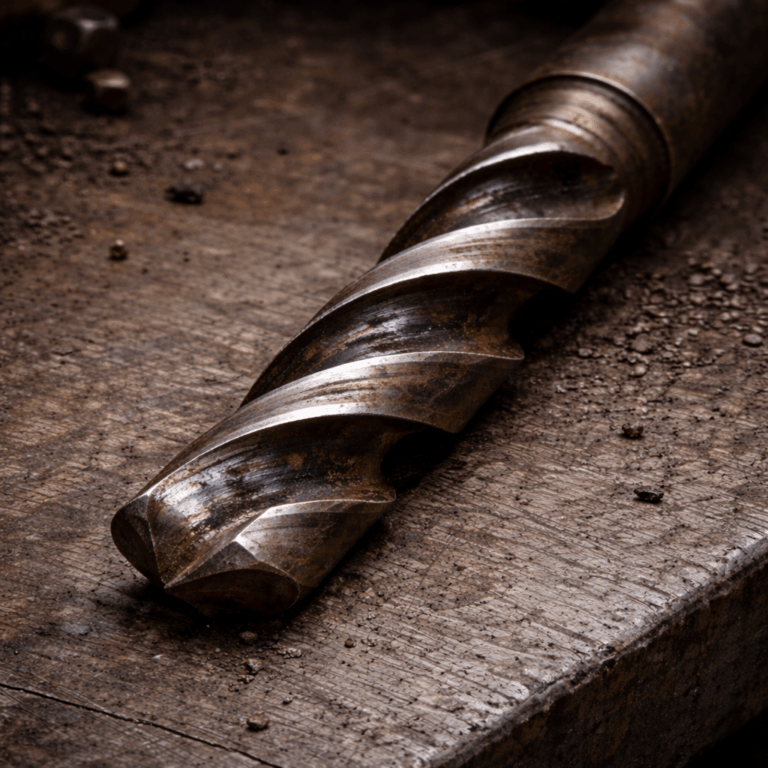
The four mechanisms that wear the cutting edge
A tool that cuts poorly is not simply “scrap”. The way it wears — where, how much, in what shape — is a message. It tells you whether the cutting speed is too high, whether the material is welding to the edge, whether the coolant is not reaching where it is needed. ISO 3685 classifies wear patterns and sets the criteria for deciding when a tool has reached end of life [1]. Yet in the workshop these criteria are often unknown: the insert is changed when it “no longer cuts”, without asking why.
Reading wear is not just about deciding when to change an insert. It is about understanding why cost per part is rising, why surface finish has deteriorated, why cycle times are growing. This article explains how to recognise the five most common wear types, what causes them, and what to do before the problem recurs.
Cutting tool wear is never random. It depends on the interaction between temperature, pressure, and chemistry at the tool-chip interface. The scientific literature identifies four main mechanisms, each dominant within a different temperature range [2][3].
| Mechanism | Temperature range | What happens | Where it appears |
| Abrasion | All (predominant < 600 °C) | Hard particles in the workpiece material scratch the flank face | Flank wear (VB) |
| Adhesion | 300 – 800 °C | Tool-chip micro-welds that tear away fragments | Built-up edge (BUE), chipping |
| Diffusion | > 800 °C (dominant > 1,000 °C) | Atomic migration from the tool into the chip | Crater on the rake face |
| Oxidation | > 700 °C | Chemical reaction with atmospheric oxygen | Notch wear at depth-of-cut boundary |
Tab. 1 — Wear mechanisms and activation conditions. Sources: Trent & Wright [2]; Molinari & Nouari [3]; Sandvik Coromant [4].
In practice, the mechanisms always act in combination. But the visible pattern on the tool reveals which mechanism dominates — and therefore which parameter to correct.
The five wear types: recognising them at a glance
Flank wear
This is the most common and predictable form. It appears as a bright, uniform band on the flank face of the tool, parallel to the cutting edge. The main cause is abrasion: hard inclusions in the workpiece material (oxides, nitrides, carbides) progressively scratch the clearance face [2][5].
ISO 3685 measures this wear using the VB parameter (mean width of the flank wear land). The standard end-of-life criterion is VB = 0.3 mm for finishing and VB = 0.5 mm for roughing [1][5]. Once the band exceeds these values, the dimensional accuracy of the part deteriorates rapidly and cutting forces increase.
What to do: reduce cutting speed (it is the parameter with the greatest impact on flank wear) and verify that the coating is suited to the workpiece material. Abrasion is particularly aggressive on alloys such as lead-free brass, where the Kappa phase acts as an internal abrasive on the cutting edge — a topic covered in detail in a dedicated article. PVD-TiAlN coatings increase abrasion resistance at medium-to-high temperatures, while CVD-Al₂O₃ adds a thermal barrier [4][6].
Crater wear
It appears as a concave depression on the rake face, in the chip-flow zone. It is caused primarily by diffusion: at high temperatures, atoms from the cemented carbide migrate into the chip due to chemical affinity [2][3]. It is typical of machining steels at high speeds with uncoated WC-Co tools, where the interface temperature can exceed 1,000 °C [3].
The ISO 3685 criterion for crater wear is KT (maximum depth) = 0.15 mm [1]. A deep crater weakens the cutting edge to the point of fracture.
What to do: reduce cutting speed (the dominant factor on temperature), select a coating with low thermal conductivity (CVD Al₂O₃ is the reference), or choose a substrate with greater chemical resistance (Ti(C,N)-based cermet) [4][6].
Built-up edge (BUE)
Layers of workpiece material weld under pressure onto the cutting edge, forming an irregular deposit that alters the cutting geometry. The BUE typically forms at low cutting speeds (indicatively below 50–80 m/min when machining steels), when the temperature is sufficient to create micro-welds but not high enough to dissolve them [2][7].
The BUE is unstable: it detaches cyclically, taking fragments of coating or substrate with it. The result is poor surface finish, unpredictable chipping of the cutting edge, and quality-control stoppages that extend cycle times [7].
What to do: increase cutting speed to move beyond the BUE formation zone, or improve lubrication. Geometries with a positive rake angle and polished rake faces reduce adhesion [4][8].
Chipping
Small fragments break away from the cutting edge irregularly. This is not gradual wear but a localised mechanical failure, caused by overloading: entry into the workpiece in interrupted cutting, vibrations, hard inclusions in the material, excessive depth of cut [4][5].
What to do: select a tougher substrate grade (higher cobalt content in WC-Co), reduce the feed at entry, check system rigidity (clamping, tool overhang, spindle wear). In interrupted cutting, a PVD coating is preferable to CVD because it is more resistant to chipping [4][6].
Plastic deformation
The cutting edge deforms — rounding or sinking — without material detaching. This occurs when the combination of pressure and temperature exceeds the yield limit of the substrate. It is common with high feeds on high-strength materials, or when the insert grade is too soft for the application [4][8].
What to do: switch to a harder grade (less cobalt, more WC), reduce cutting speed and feed, improve cooling. A coating with low thermal conductivity (CVD-Al₂O₃) reduces the temperature reaching the substrate [4][6].
Diagnostic table: symptom → cause → action
This table summarises the decision path. By examining the tool, the pattern is identified, the probable cause is traced, and the corrective action is decided.
| What you see | Wear type | Probable cause | Process impact | First action | Second action |
| Uniform bright band on the flank face | Flank wear (VB) | Abrasion from Vc too high or wear-resistant grade inadequate | Progressive dimensional drift; rising cutting forces | Reduce Vc by 10–15 % | More wear-resistant grade / PVD-TiAlN coating |
| Concave depression on the rake face | Crater wear (KT) | Diffusion from excessively high temperature | Risk of sudden fracture; extended machine downtime | Reduce Vc by 15–20 % | CVD-Al₂O₃ coating or cermet substrate |
| Irregular deposit on the cutting edge | BUE | Vc too low, poor lubrication, adhesive material | Surface finish out of specification; cycle times extended by rework | Increase Vc by 15–20 % | Positive rake geometry / polished rake face |
| Irregular breakaways from the cutting edge | Chipping | Mechanical overload, vibrations, insufficient rigidity | Sudden rejects; possible workpiece damage | Reduce feed at entry | Tougher grade (higher Co) / PVD vs CVD |
| Deformed cutting edge, rounded or depressed | Plastic deformation | Pressure/temperature beyond the substrate yield limit | Tolerances out of range; cascading accelerated wear | Reduce Vc and feed | Harder grade (less Co) / CVD-Al₂O₃ |
Tab. 2 — Diagnostic cause-effect-action table. Sources: ISO 3685 [1]; Sandvik Coromant [4]; Mitsubishi Materials [8]; Alabdullah et al. [5].
The three wear phases: when to intervene
Flank wear (the most monitored) follows a characteristic three-phase curve, well documented in the literature [1][2][9].
| Phase | Indicative VB | What happens | Cosa fare |
| 1 — Break-in | 0.05 – 0.10 mm (rapid) | The micro-irregularities of the new cutting edge round off rapidly | Normal. No action required. |
| 2 — Steady-state wear | 0.10 – 0.30 mm (gradual) | Linear and predictable wear; this is the useful working zone | Monitor VB. Plan the tool change before the limit is exceeded. |
| 3 — Accelerated wear | > 0.30 mm (rapid) | The cutting edge loses efficiency: forces and temperatures rise exponentially | Immediate replacement. The tool is damaging the workpiece and is at risk of fracture. |
Tab. 3 — The three progressive wear phases. Source: ISO 3685 [1]; Serra et al. [9].
The critical point is the transition from phase 2 to phase 3. Changing the tool too early wastes usable life. Waiting too long risks rejects, rework, and catastrophic fracture. The goal is to operate as long as possible in phase 2 and change before reaching phase 3.
Operational checklist: what to check after every tool change
- Examine the cutting edge before discarding it. Is the wear uniform on the flank? Is there a crater? A deposit? Chipping? The pattern is the first data point.
- Cross-reference with the diagnostic table (Tab. 2). Identify the wear type and the probable cause.
- Record the number of parts or cutting time. If the tool is in phase 3 (VB > 0.3 mm), you waited too long. If VB < 0.15 mm, you changed it too early.
- Inspect the chip. A discoloured chip (blue/purple) signals excessive temperatures. A chip with a dull, irregular surface indicates BUE.
- Check the surface finish of the part. A sudden deterioration in roughness is often the first visible sign that wear has exceeded the useful limit.
- Decide: correct the parameter or change the tool? If the same pattern recurs across several consecutive tools, the problem lies in the process, not the individual insert.
- Assess reconditioning. Solid carbide tools with uniform flank wear and no chipping are the ideal candidates. If the crater has penetrated the substrate deeply, reconditioning may not be sufficient.
Conclusions
Tool wear is not an event — it is a process that speaks. Every workshop generates free data about what is happening to the cutting edge: the only requirement is to read it systematically.
Three key takeaways. First: a tool must be examined after use, not only when it breaks. Second: the wear type indicates the cause; the diagnostic table is the tool for connecting the two. Third: operating in the stable wear zone (phase 2) and changing before phase 3 is the strategy that balances tool cost and part quality.
For special solid carbide tools, specialist reconditioning can restore up to 90 % of the original tool life — provided that wear has been managed correctly and has not damaged the geometry beyond recovery. MadTools designs tools with geometries that minimise wear specific to the customer’s material — including reinforced rake-angle geometries for high-strength materials such as titanium and Inconel — and offers an HM tip reconditioning service that restores the tool to original specifications. If the wear pattern on your tools is telling you about a recurring problem, contact us: we can analyse it and design the solution.
Sources and references
[1] ISO 3685:1993 — Tool-life testing with single-point turning tools. International Organization for Standardization.
[2] E.M. Trent, P.K. Wright — Metal Cutting, 4th Edition. Butterworth-Heinemann, 2000.
[3] A. Molinari, M. Nouari — “Modeling of tool wear by diffusion in metal cutting”. Wear, Vol. 252, pp. 135-149, 2002. (ScienceDirect)
[4] Sandvik Coromant — “Wear on cutting edges” e “Cutting tool materials”. sandvik.coromant.com (consultato febbraio 2026).
[5] M. Alabdullah — “Impacts of Wear and Geometry Response of the Cutting Tool on Machinability of Super Austenitic Stainless Steel”. International Journal of Manufacturing Engineering, 2016. (Wiley)
[6] D. Dolinšek, J. Šuštaršič, J. Kopač — “Wear mechanisms of cutting tools in high-speed cutting processes”. Wear, Vol. 250, 2001. (ScienceDirect)
[7] H. Opitz et al. — “The effect of the built-up edge (BUE) on the wear of cutting tools”. Wear, 1971. (ScienceDirect)
[8] Mitsubishi Materials — “Causes of tool damage”. mmc-carbide.com (consultato febbraio 2026).
[9] R. Serra et al. — “Experimental Evaluation of Flank Wear in Dry Turning from Accelerometer Data”. International Journal of Acoustics and Vibration, Vol. 21, No. 1, 2016.