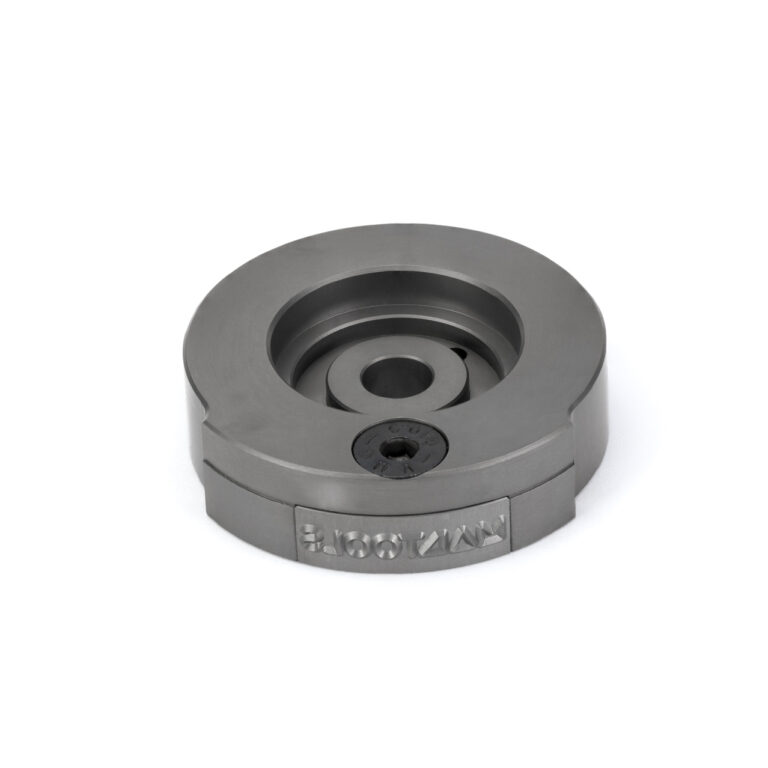
1. Why mechanical marking has returned to the centre of the production agenda
A part without a readable mark is an untraceable part. And an untraceable part — in medical as in automotive — is a part that does not exist.
EU MDR Regulation 2017/745 requires UDI marking directly on reusable medical devices, with deadlines between December 2027 and December 2028 depending on the risk class [1][2]. The IATF 16949 standard, clause 8.5.2.1, requires automotive suppliers to maintain documented traceability plans from material intake to delivery [3]. In aerospace, AS9100 and NADCAP prescribe permanent marking using low-stress methods on flight-critical parts [4].
Mechanical marking — rolls, punches, knurling tools — remains the dominant technology when deep engravings, resistant to post-treatments and directly integrable into the production cycle on lathes and presses are required. This article compares the available technologies with data on depth, force, readability and objective selection criteria.
2. Mechanical marking technologies: how they work
2.1 Marking roll
A hardened steel cylinder with characters engraved on its circumference. Mounted on a lathe or transfer machine, it rolls against the rotating workpiece, imprinting the mark through progressive contact. The key advantage: far less force is required compared to a stamp punch, because only a fraction of the message is in contact at any given moment [5].
Force required: pneumatic machines 1.5–3 tonnes; hydraulic up to 6–14 tonnes for hard materials [6].
2.2 Stamp punch (impact stamp)
Acts with a single downward impact via manual or hydraulic press. Manual presses reach up to 6.5 tonnes of controlled force [7].
Available variants: linear punches for rolling on rotating bar, flat impact punches, male/female dies for sheet metal stamping with through-relief.
2.3 Dot peen (CNC micropercussion)
A CNC-controlled tungsten carbide stylus creates micro-indentations on the surface. Available in pneumatic (greater depth) or electromagnetic (greater precision) versions. Typical speed: up to 20 characters per second [9]. It is the most flexible technology for variable content such as serial numbers and DataMatrix codes.
Table 1. Comparison of mechanical marking technologies.
| Technology | Typical depth | Force required | Speed | Typical application |
| Marking roll | 0,05–0,3 mm | 1.5–3 t (pneum.) | Continuous, in-cycle | Cylindrical parts on CNC lathes and transfer machines |
| Stamp punch | 0,1–0,5 mm | 2–6.5 t (press) | Single stroke | Flat parts on manual and hydraulic presses |
| Male/female punch | Through (raised relief) | 3–14 t (hydraul.) | Single stroke | Sheet metal, nameplates |
| Pneumatic dot peen | 0,1–0,3 mm | N/A (point impact) | Up to 20 char./s | Serialisation, DataMatrix |
| Combined knurling | 0,1–0,5 mm | Variable | Continuous, in-cycle | Knurling + marking on lathes |
Sources: GT Schmidt [6], Durable Technologies [7], Kwik Mark [9]
3. The regulatory framework: what the standards require
The European UDI (Unique Device Identification) system, introduced by EU MDR 2017/745, requires every reusable medical device to carry a code in human-readable format (HRI) and machine-readable (AIDC) directly on the device [1].
UDI deadlines: Class III and implantable IIb by 31 December 2027. Class IIa, non-implantable IIb and Class I by 31 December 2028 [2].
In automotive, clause 8.5.2.1 of IATF 16949 requires an analysis of internal, customer and regulatory traceability requirements, with the development of documented plans based on risk level [3]. Permanent mechanical marking remains preferred where the part undergoes aggressive surface treatments.
Table 2. Regulatory requirements for part traceability.
| Standard | Sector | Marking requirement | Key deadlines |
| EU MDR 2017/745 (UDI) | Medical | UDI code (HRI + AIDC) directly on the reusable device | Class III: Dec. 2027 Class I–IIb: Dec. 2028 |
| IATF 16949 §8.5.2.1 | Automotive | Unique ID from incoming material to delivered product; documented plan | In force (mandatory for OEM suppliers) |
| AS9100 / NADCAP | Aerospace | Permanent marking on flight-critical parts; low-stress methods | In force |
| FDA 21 CFR 801.45 | US Medical | UDI directly on the device in permanent format for reusables | In force since 2018 |
Sources: EU Regulation 2017/745 [1], Elexes [2], IATF 16949 [3], FDA 21 CFR 801.45 [11]
4. Readability after surface treatments: the data
The most critical issue in mechanical marking is the survival of the mark after post-treatments. A Laserax study on A356 aluminium parts quantified the loss of contrast and readability of DataMatrix codes after shot blasting, painting and e-coating [12].
The results show that the cell size of the DataMatrix is the determining factor:
- After shot blasting: 0.4 mm cells unreadable; 0.6–0.8 mm cells readable (contrast loss ≈10%) [12].
- After e-coating: minimum threshold 0.75 mm; best results with 1.25 mm cells [13].
- Shot blasting + e-coating (most severe case): deep marking with at least 6 passes, 0.6 mm cells [13].
For conventional mechanical marking (rolls and punches), the principle is the same: the engraving depth must exceed the roughness profile generated by the surface treatment. Shot blasting generates typical profiles of 25 to 127 μm [14]. Therefore, a marking 0.05 mm deep will not survive; at least 0.15–0.2 mm is required to ensure readability.
Table 3. Marking readability after surface treatments.
| Treatment | Effect on marking | Minimum depth | DataMatrix cell size | Recommended action |
| Painting | Partial coverage | ≥0,15 mm | ≥1,0 mm | Mark pre-painting with extra depth |
| Shot blasting | Surface abrasion | ≥0,2 mm | ≥0,6 mm | Deep marking; verify readability post-process |
| E-coating | Uniform film | ≥0,1 mm | ≥1,25 mm | Large cells, sufficient contrast |
| T4/T6 heat treatment | Discolouration, min. physical effect | ≥0,05 mm | Standard | Readability generally preserved |
| Shot blasting + painting | Severe combined effect | ≥0,3 mm | ≥0,6 mm deep | Deep marking mandatory; validate with samples |
Sources: Laserax / NADCA 2016 [12][13]; SSPC/Elcometer [14]
5. Marking and part integrity: the stress factor
Every mechanical marking operation introduces localised plastic deformation. In materials that work-harden rapidly, such as stainless steels, this can generate stress concentrators that reduce the fatigue life of the component [15].
In aerospace, electrochemical marking is the only authorised method on Flight Critical parts because it introduces neither mechanical stresses nor thermally altered zones [4].
For non-fatigue-critical components, the solutions are geometric:
- Punches with a rounded face (Aerocut type): they distribute the force, reducing stress peaks at the contact point [7].
- APIQ low-stress punches (oil & gas sector): they combine interrupted and rounded faces to minimise stress concentration [7].
The practical rule is: single stroke with calibrated force, never multiple light strokes that progressively work-harden the surface.
6. Operational checklist before ordering a marking tool
- Define the marking content: fixed text, variable text, DataMatrix code?
- Measure the available space on the part and verify the wall thickness in the marking area.
- Identify the planned post-treatments (painting, shot blasting, heat treatment) and define the minimum depth.
- If the part is fatigue-critical, verify structural integrity requirements and evaluate low-stress geometries.
- Specify in the technical drawing: character height, engraving depth, marking position.
- Validate with marked + treated samples before series production.
- Periodically check the marking tool for wear (incomplete characters = time for replacement).
7. Quick diagnosis: when something goes wrong
A mini decision tree for the most common problems during mechanical marking:
| Symptom | Probable cause | Corrective action |
| Mark unreadable after painting | Insufficient depth relative to film thickness | Increase depth to ≥0.15 mm; verify with painted samples |
| Incomplete or smeared characters | Marking tool wear or workpiece misalignment | Check roll/punch condition; verify centring and pressure |
| DataMatrix not readable by scanner | Cell size too small relative to surface roughness | Increase cell to ≥0.6 mm; check reading angle |
| Part deformation after marking | Excessive marking force or insufficient wall thickness | Reduce tonnage; consider roll marking technology (distributed force) |
| Surface cracks near the marking | Stress concentration on work-hardened materials (e.g. stainless steel) | Low-stress punches (rounded face) or APIQ geometries; single stroke |
| Marking disappears after shot blasting | Depth below the shot blasting profile (≈25–127 μm) | Deep marking ≥0.2 mm; validate on shot-blasted samples |
Table 4. Quick diagnosis for common issues. Sources: GT Schmidt [6], Durable Technologies [7], Laserax [12][13], SSPC [14]
8. When to choose mechanical marking: decision criteria
Mechanical marking excels when depth, resistance to post-treatments and direct integration into the machine cycle are required. The cost of a marking tool is a fraction of the cost of a laser system (from €35,000) or CNC dot peen (from €6,000) [16]. The limitation is flexibility: a fixed-character roll works for logos and constant texts, not for variable serialisation.
Table 5. Selection criteria: mechanical marking vs alternatives.
| Criterion | Choose mechanical marking (roll/punch) | Consider alternative (laser/dot peen) |
| Production volume | High volume, fixed or semi-fixed text | Frequent variability (serialisation, batches) |
| Required depth | Marking must withstand shot blasting, painting, heavy-duty use | Surface marking sufficient (optical contrast) |
| Structural integrity | Ductile materials, adequate wall thicknesses | Fatigue-critical components, thin walls, brittle materials |
| Initial budget | Low (tool costing a few hundred euros) | Medium-high (laser from €35,000+, dot peen from €6,000+) |
| Machine integration | Easy on existing lathes, presses, transfer machines | Requires dedicated station or specific CNC integration |
Sources: Laserax [16], GT Schmidt [6], DirectIndustry [4]
9. Conclusions: key takeaways
Mechanical marking is not a detail: it is the bridge between the part and its identity throughout the entire supply chain.
The question is not whether mechanical marking is needed, but which technology, at what depth, on which material. UDI regulations in medical and IATF 16949 in automotive make traceability a requirement, not an option.
The choice depends on three variables: required depth after treatment, production volume and structural integrity constraints.
MadTools designs and manufactures marking tools — marking rolls, punches, knurling tools and custom-design special tooling — calibrated to customer specifications: material, depth, part geometry. For cases where standard solutions fall short, the team of 5 designers develops custom solutions from scratch.
Sources and references
[1] Regulation (EU) 2017/745 (EU MDR), Article 27 — Unique Device Identification system. Official Journal of the European Union.
[2] Elexes, “EU MDR 2017/745 — FAQs”, elexes.com, updated 2025. Deadlines: Class III Dec. 2027, Class I–IIb Dec. 2028.
[3] IATF 16949:2016, Clause 8.5.2.1 — Identification and Traceability (Supplemental).
[4] DirectIndustry, “Choosing the Right Marking Machine — Buying Guide”, guide.directindustry.com, 2024.
[5] Pannier Corporation, “Roller Dies for Continuous Marking”, pannier.com, 2025.
[6] GT Schmidt, “Types of Traditional Marking: Roll Marking Machines” and “Steel Stamps and Marking Dies”, gtschmidt.com.
[7] Durable Technologies, “Marking Stainless Steel Without Stress Concentration: A Practical Guide”, durable-tech.com, 2025.
[9] Kwik Mark, “Dot Peen Marking Machines”, kwikmark.com.
[11] FDA, 21 CFR 801.45 — Devices; current good manufacturing practice.
[12] Laserax / NADCA, “Traceability and Laser Marking of Die Castings”, laserax.com.
[13] Laserax, “The Challenges of Direct Part Marking (DPM) and Post Process Treatments”, laserax.com.
[14] SSPC / Elcometer, “Inspection After Surface Preparation”. Shot blasting profile: 25–127 μm.
[15] Chinese Journal of Mechanical Engineering, “Effect of Machined Surface Integrity on Fatigue Performance of Metal Workpiece: A Review”, 2021.
[16] Laserax, “Laser Markers vs Dot Peen Marking Machines: What to Choose and Why”, laserax.com, 2025.