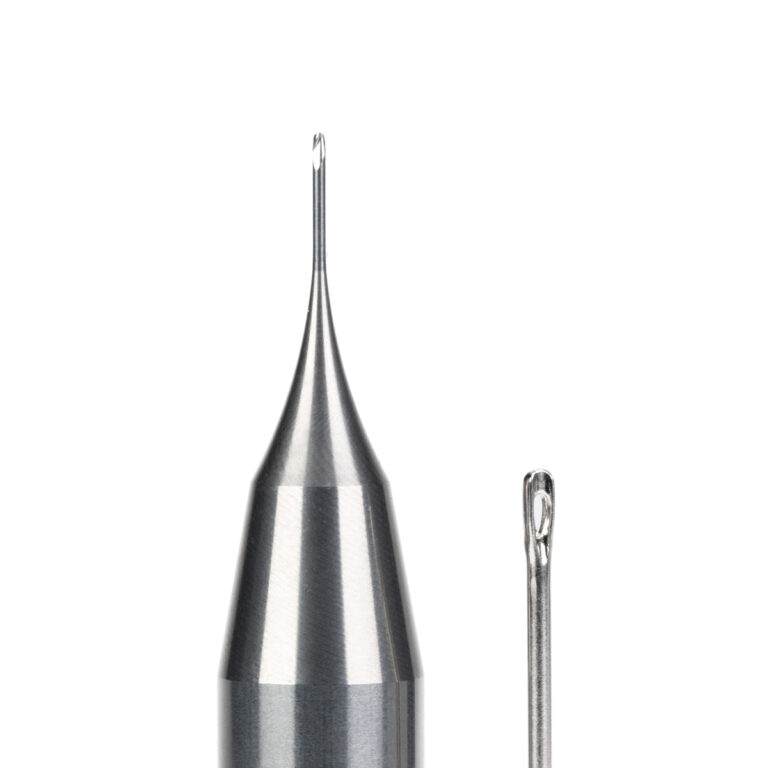
Technical guide to solid carbide microtools: tolerances, dental, medical and aerospace applications, selection criteria.
In the dental sector, a deviation of 3 micrometers can compromise the integration of an implant. Under these extreme conditions, conventional tools are not sufficient: solid carbide microtools are required, designed to operate where error margins are virtually zero.
If you work in the production of miniaturized components with diameters below 3 mm – in the dental, medical, aerospace sectors or in precision mold making – you have probably already asked yourself some key questions:
• When is a standard tool no longer adequate?
• What tolerances are realistically achievable on small diameters?
• How do you choose the right material and geometry for the application?
• Why do apparently similar microtools have very different costs?
This guide answers these questions with a technical and practical approach, helping you choose the right tool, optimize processes, and reduce scrap and machine downtime.
What microtools are: definition and characteristics
A terminological clarification
In industrial language, the term microtool is used in two meanings:
• Strict sense: tools with diameter < 1 mm
• Extended sense: precision tools with diameter < 3 mm
In this guide, the term microtools covers the 0.5–3 mm range, while acknowledging that technically the 1–3 mm range falls into small-diameter high-precision tools.
Distinctive characteristics
Microtools are solid carbide cutting tools (tungsten carbide) designed for extreme-precision machining.
| Characteristic | Microtools (0.5–3 mm) | Standard tools (> 6 mm) |
| Diameter tolerance | < 6 µm | 20–50 µm |
| Cutting edge roughness | Ra < 0.2 µm | Ra 0.4–0.8 µm |
| Quality control | 100% inspection | Sampling |
When they are truly necessary
1. Small machining diameters (< 3 mm)
• Drilling for M3 screws and smaller
• Milling of miniaturized details
• Cooling channels in molds
• Holes for precision pins
2. Tight dimensional tolerances
• Fits with clearances < 10 µm
• H6–H7 components
• Optical parts
• Automated assemblies
3. Difficult materials on small cross-sections
• Titanium Ti-6Al-4V
• Cobalt-chrome alloys
• Technical ceramics (zirconia, alumina)
• Reinforced PEEK
• Hardened steels > 50 HRC
4. Typical applications
• Dentistry and implantology
• Implantable medical devices
• Electronic micro-connectors
• High-end watchmaking
• Miniaturized aerospace components
Main applications
Dental sector and implantology
Dentistry is currently the world’s largest user of microtools.
Milling tools for prosthetics and crowns
• Diameters: 0.5–1.5 mm
• Materials: zirconia, CoCr, PMMA, titanium
• Geometries: spherical, cylindrical, conical
• Critical requirement: Ra < 0.2 µm to prevent bacterial micro-retention
Implantology drills
• Positioning accuracy < 0.05 mm
• Geometries dedicated to specific anatomical sites
• Optimized cooling to avoid bone necrosis (> 47 °C)
Medical sector
Typical applications:
• Endoscopic instrumentation (channels < 0.5 mm)
• Cardiac micro-valves
• Pacemaker components
• Surgical micro-instruments
Most common materials:
• Titanium Ti-6Al-4V
• Stainless steel 316L
• CoCr alloys
• Medical-grade PEEK
Automotive and aerospace
Automotive
• High-precision injectors
• Miniaturized sensors
• Micro-valves
Aerospace
• Turbine blade cooling channels (0.5–1.5 mm)
• High-density avionics connectors
• Lightweight satellite components
Why solid carbide is essential
The physical limits of HSS below 3 mm
At small diameters, HSS shows structural limits that cannot be overcome:
• Brittleness
• Excessive deflection
• Rapid wear
• Inability to maintain tolerances < 10 µm
Advantages of solid carbide
| Property | Solid carbide | HSS |
| Hardness | 1500–1800 HV | 800–900 HV |
| Elastic modulus | 600 GPa | 210 GPa |
| Bending strength | > 4000 MPa | ~2500 MPa |
Realistic tolerances: marketing vs reality
❌ “Sub-micron precision guaranteed”
✅ Tolerances < 6 µm are an excellent and repeatable result
| Parameter | Typical value |
| Diameter | < 6 µm |
| Concentricity | < 5 µm |
| Cutting length | ±10 µm |
| Angles | ±15′ |
| Roughness | Ra < 0.2 µm |
How to choose the right microtool
Practical checklist
- Material to be machined
- Type of operation
- Machine capability
- Tolerances actually required
- Production volumes
Fundamental rule:
👉 Maximum tool length ≈ 3 × diameter
Why microtools cost more
A high-quality microtool does not cost more because of margin, but because of real complexity:
• Ultra-fine raw materials
• Longer grinding times
• 100% dimensional inspection
• Lower production yields
• Highly specialized know-how
The higher cost is often largely offset by:
• Fewer breakages
• Less scrap
• Greater process stability
When production requires machining diameters of 0,5–3 mm with tight tolerances, the choice of microtool cannot be left to chance. Geometry, material, coating, and quality control make the difference between an unstable process and a truly reliable one.
For this reason, collaboration with specialized manufacturers like MadTools becomes a concrete competitive advantage.